
Rebuilding VITREA after the carve-out
When Fresenius SE implemented its strategic exit from the European rehabilitation and healthcare services business in October 2024, it was the decisive moment. The rehabilitation sub-business was operationally strong but limited by the Group structure. PAI Partners recognised the potential to build an independent European rehabilitation platform with a concrete investment strategy. The mission: to become the leading rehabilitation provider in Europe through targeted acquisitions - such as those of the nine Paracelsus clinics.
An ambitious goal that required the reorganisation of structures, management and culture without compromising the current core business. The company brought undconsorten on board as a consulting partner for this journey under the new VITREA brand.
Organisational development without legacy issues - the carve-out as a design opportunity
A carve-out is first and foremost a complex process: dissolving existing structures, cutting dependencies, establishing the ability to act independently - and all this without interrupting operations. In the case of VITREA, there was also the fact that the old group structure was organised by country. This led to a broad range of inpatient rehabilitation, outpatient rehabilitation and care facilities, which, however, lacked a common management logic: three largely independent country organisations, hardly any cross-country cooperation, no common management logic. The new independent organisation lacked clear responsibilities between the head office and the regions. The question of how to build a scalable organisation that would enable rather than hinder further growth was unanswered.
Diagnosis and design principles as a foundation
Together with undconsorten, we began with a robust situation analysis: Where does the organisation stand? What must and should be retained? What needs to change fundamentally? On this basis, design principles were developed in executive workshops. These served as normative guidelines and a decision-making compass for all further organisational decisions. Rather than making structural decisions based on emotion or hierarchy, principle-based work created the basis for a consistent organisation.
Architecture: clinic clusters, regions, functions
The new joint organisational structure groups clinics into clusters where geographical proximity, size and specialist focus make sense. These clusters are in turn subordinate to regions. The control logic and interfaces to the head office are defined in a binding manner. The structure is deliberately designed to be flexible: Regions can be separated or merged in the event of further growth. Scalability is thus anchored in the architecture.
Structured organisational concepts have been developed for all central functions (HR/People & Culture, Finance, IT, Purchasing, Marketing, Legal, Operations). The key question here is: who decides what - and where is the boundary between headquarters and the region?
The answer follows a consistent primacy: the clinics and their operational performance take centre stage - all other areas see themselves as their service providers.
Management and governance reorganised
The Executive Board departments (CEO, COO, CFO) have been clearly focussed on regions and functions. The governance architecture regulates meeting structures, decision-making channels and escalation mechanisms. The management architecture transparently anchors roles, responsibilities and management logic in the overall model. Role profiles, use cases design core activities and interfaces in a concrete and operationalisable way. A newly established Project Management Office (PMO) ensures transparency and prioritisation of central initiatives and continuously monitors implementation.
Participation as a success factor
It was clear from the outset that this transformation could only succeed together with the managers - not for them. One of the key realisations of this project was that genuine participation is also possible under time pressure. Particularly in a phase of great uncertainty - parallel to the ongoing acquisition and integration of the nine Paracelsus clinics - the targeted involvement of key individuals was critical to success. Organisational development was not seen as a management board project, but as a joint design process. Key individuals were involved at an early stage through individual 1:1 communication in order to secure their commitment to the company and release implementation energy.
Further development in line with the claim "Stronger than yesterday"
The result is a powerful, scalable organisation with a uniform management logic that also leaves room for country-specific requirements. Central functions such as finance, purchasing and HR are bundled across countries; at the same time, the regions are given far-reaching entrepreneurial freedom - because innovations are created equally in the clinics and in the management functions.
"Centrally lean, regionally strong."
Dr York Dhein, COO VITREA Group
Today, VITREA is not only better positioned operationally, but is also structurally ready for what comes next. Not reorganised, but rebuilt from the ground up. A transformation that undconsorten accompanied for over 1.5 years with varying degrees of intensity - from the initial diagnosis through to operational implementation. Organisational development was consistently understood as a cultural task: The new claim "Stronger than yesterday" in VITREA's new brand world is representative of the mindset of the employees and stands for a new shared identity. This foundation now supports the growth ambition: further acquisitions, a stronger market presence and consolidation to become Europe's leading rehabilitation platform.
"During the carve-out and integration, undconsorten helped us to consistently align our organisation and management with the new business requirements. The combination of clarity in structures and support in pragmatic implementation is a key success factor for our ability to act today."
Klaus Schuster
CEO
Facts about the company
VITREA is one of Europe's leading rehabilitation providers. The company operates 80 inpatient and outpatient facilities in Germany, Austria and Switzerland. With around 14,000 employees and more than 200,000 rehabilitation patients per year, VITREA stands for high-quality, evidence-based rehabilitation. It is owned by PAI Partners and Fresenius SE.
Insight
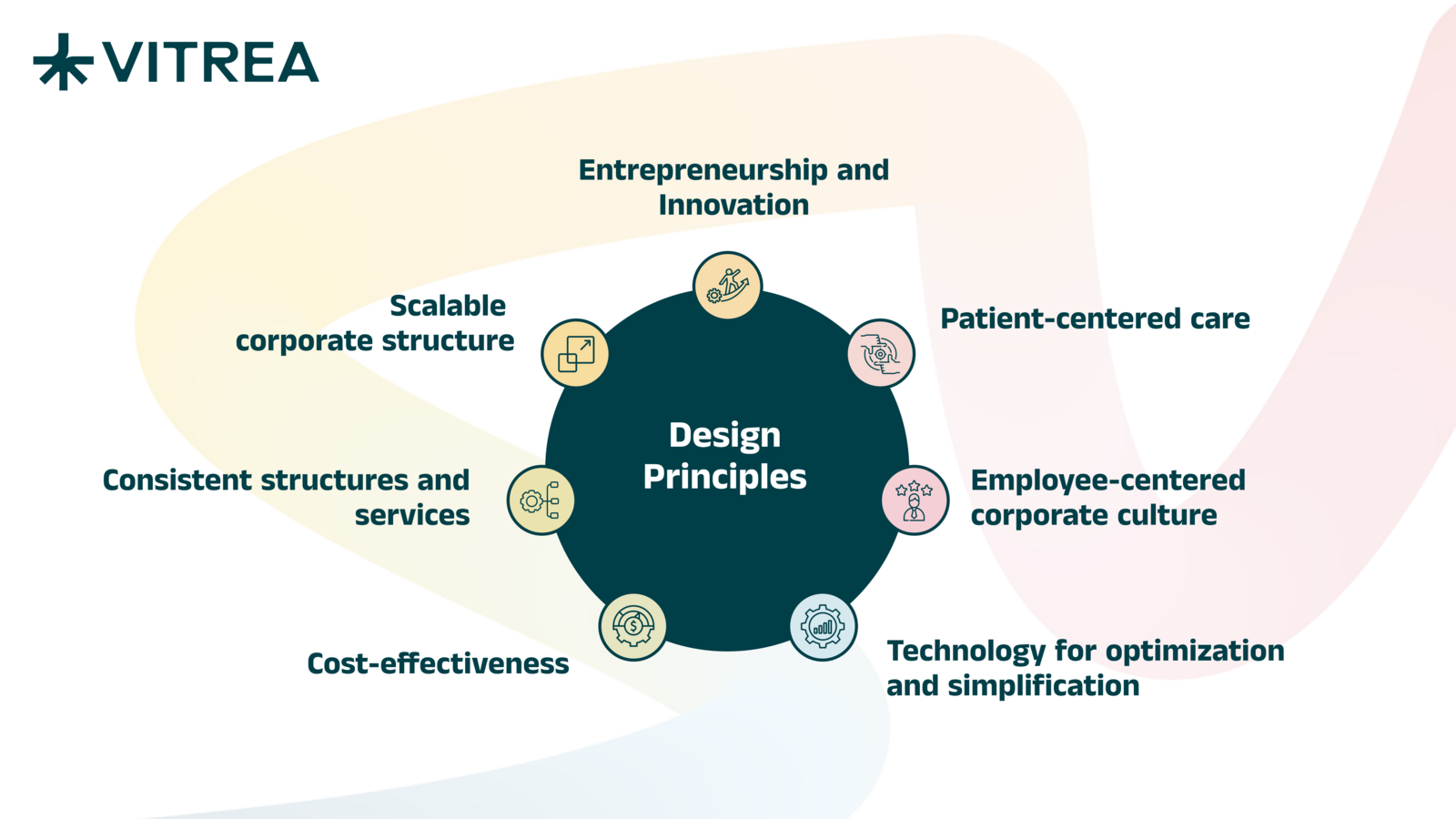
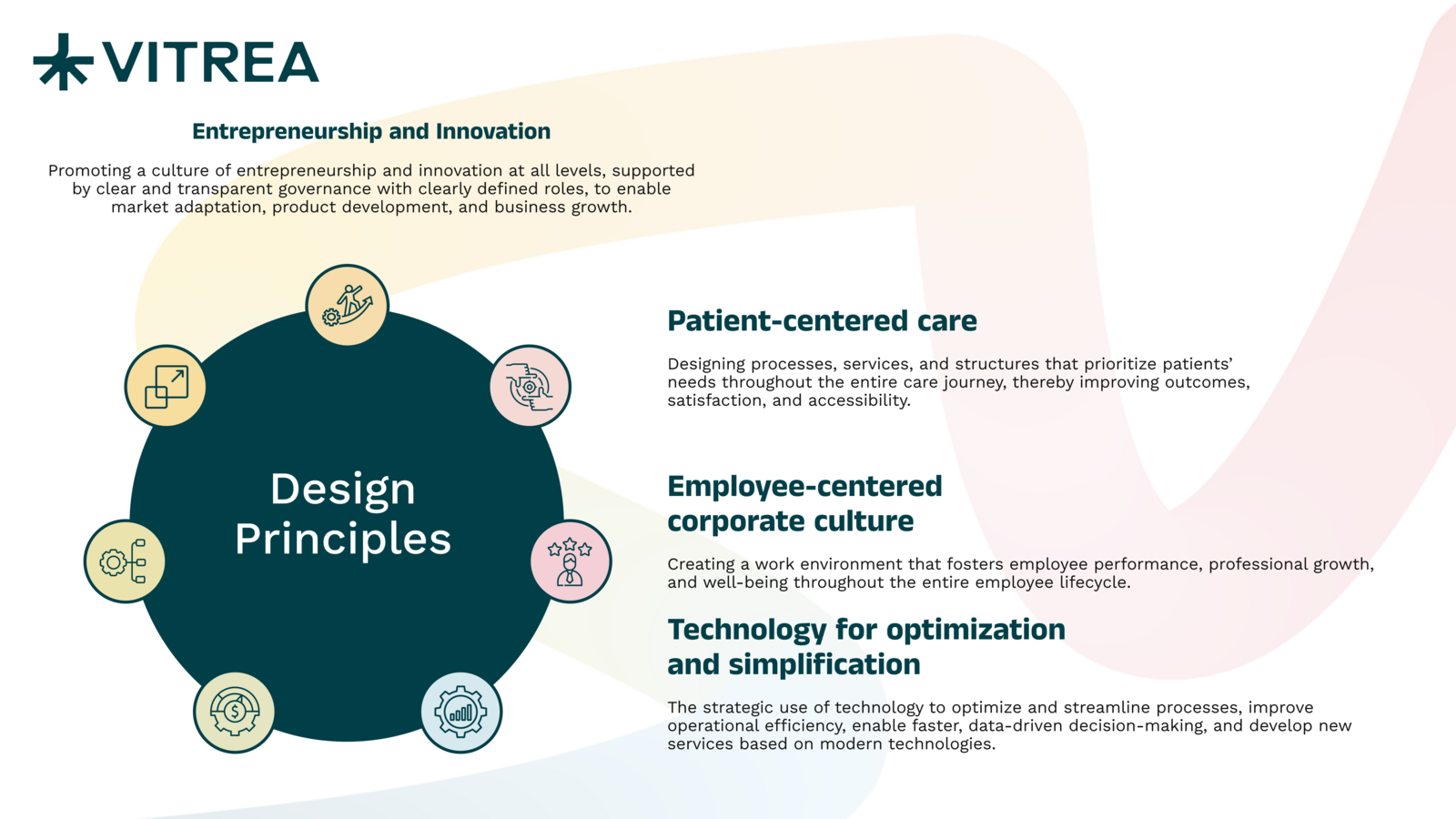
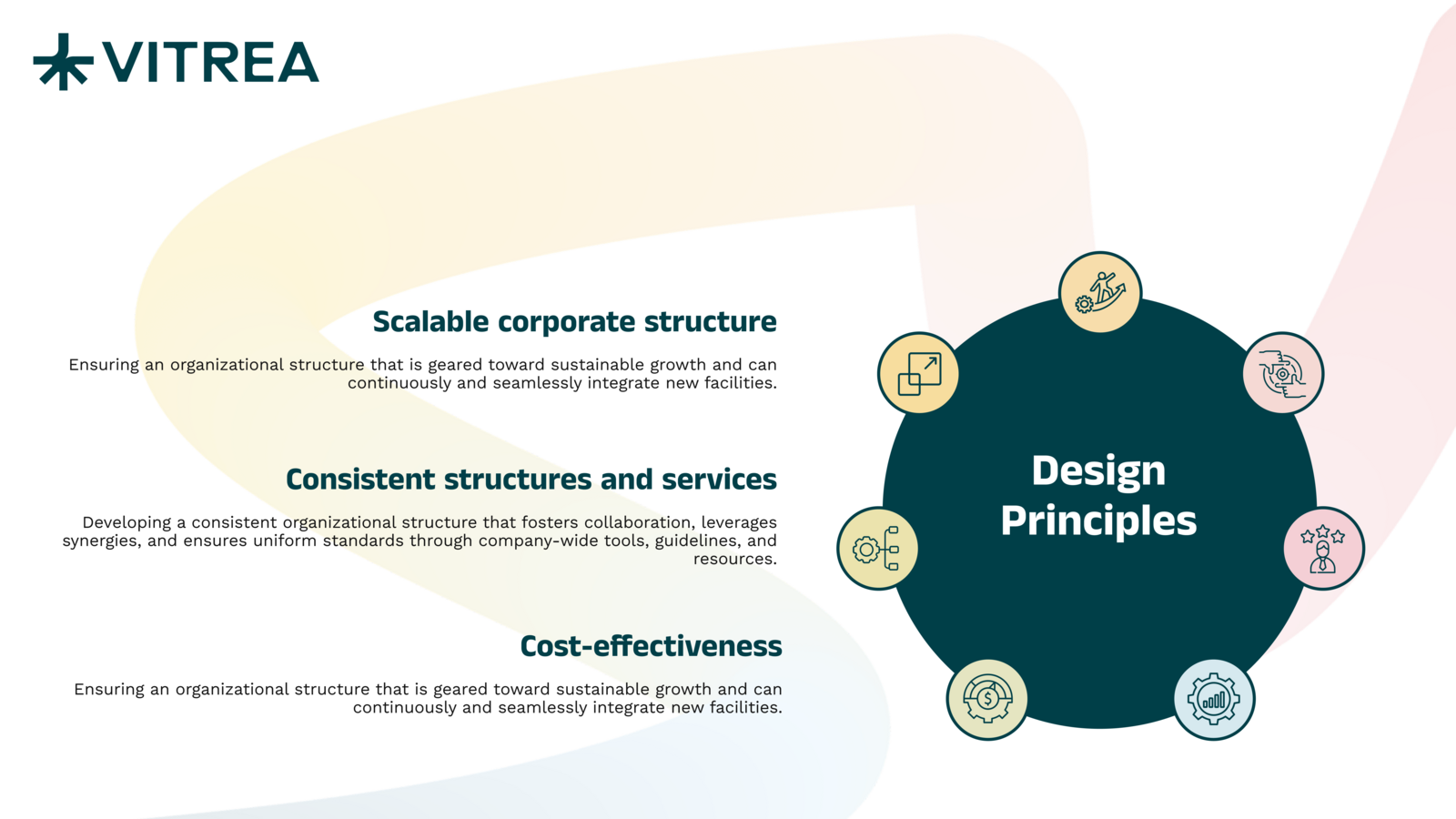
VITREA NEXT Org design principles
The transformation did not start with organisational charts, but with principles. These seven design principles formed the decision-making compass for the entire organisational structure - from management logic to governance. What unites them is the consistent focus on what VITREA should be as an independent company.
Broadening perspectives - further topics
Successful organisations are characterised by a common direction, effective positioning, committed employees, efficient managers, high-performing teams, a constructive culture and experience with change. These characteristics are closely interlinked and reinforce each other.
Operating Model
Efficient division of labour for sustainable success - A functioning operating model ensures clear tasks and roles as well as efficient processes that are aligned with the strategic goals of the organisation. It forms the basis for an efficient and agile organisation. We support you in optimising your division of labour and efficiently promoting collaboration and leadership in your organisation. Our approach helps you to quickly adapt your structure to changes and secure your long-term performance.
Corporate culture
Strengthening teams and organisations with effective leaders. Our approach is based on the conviction that organisational structures only really come to life through the enthusiasm and commitment of employees. It is about transforming formal ideas into tangible reality - and this can only succeed with each individual in the team.
Strategic orientation
Clear and common goals are essential for successful organisations. They provide orientation in the market and for internal collaboration. Linking business strategy with vision and purpose is crucial. The larger the organisation, the more important it is to have a clear direction. Our approach anchors common goals in structures and processes, supported by proven methods to ensure a high willingness to change.
Talk to us
Do you have any questions or are you interested in working with undconsorten? Together we can discuss how we can make your organisation more successful with a holistic approach and functional expertise with a focus on sustainability, implementation and efficiency.
Our experts look forward to hearing from you!