H2O2 – Organisation and HR
How HR plays a key role in shaping the operating model
Series of events, April – October 2026, in cooperation with the BPM – Federal Association of HR Managers | Online & PMK Berlin | For HR managers & organisational development experts | Series completed. Recordings and a comprehensive white paper are now available
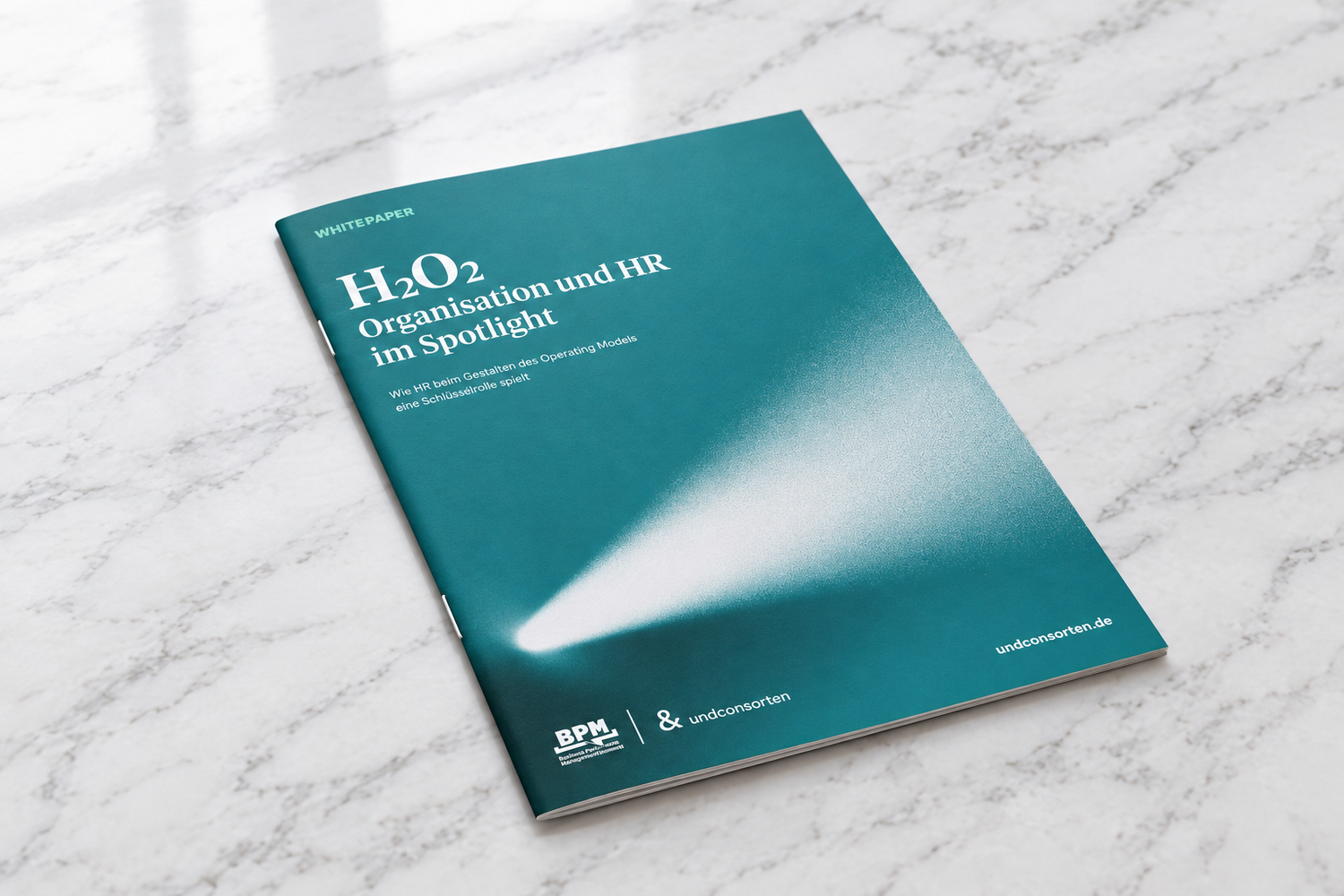
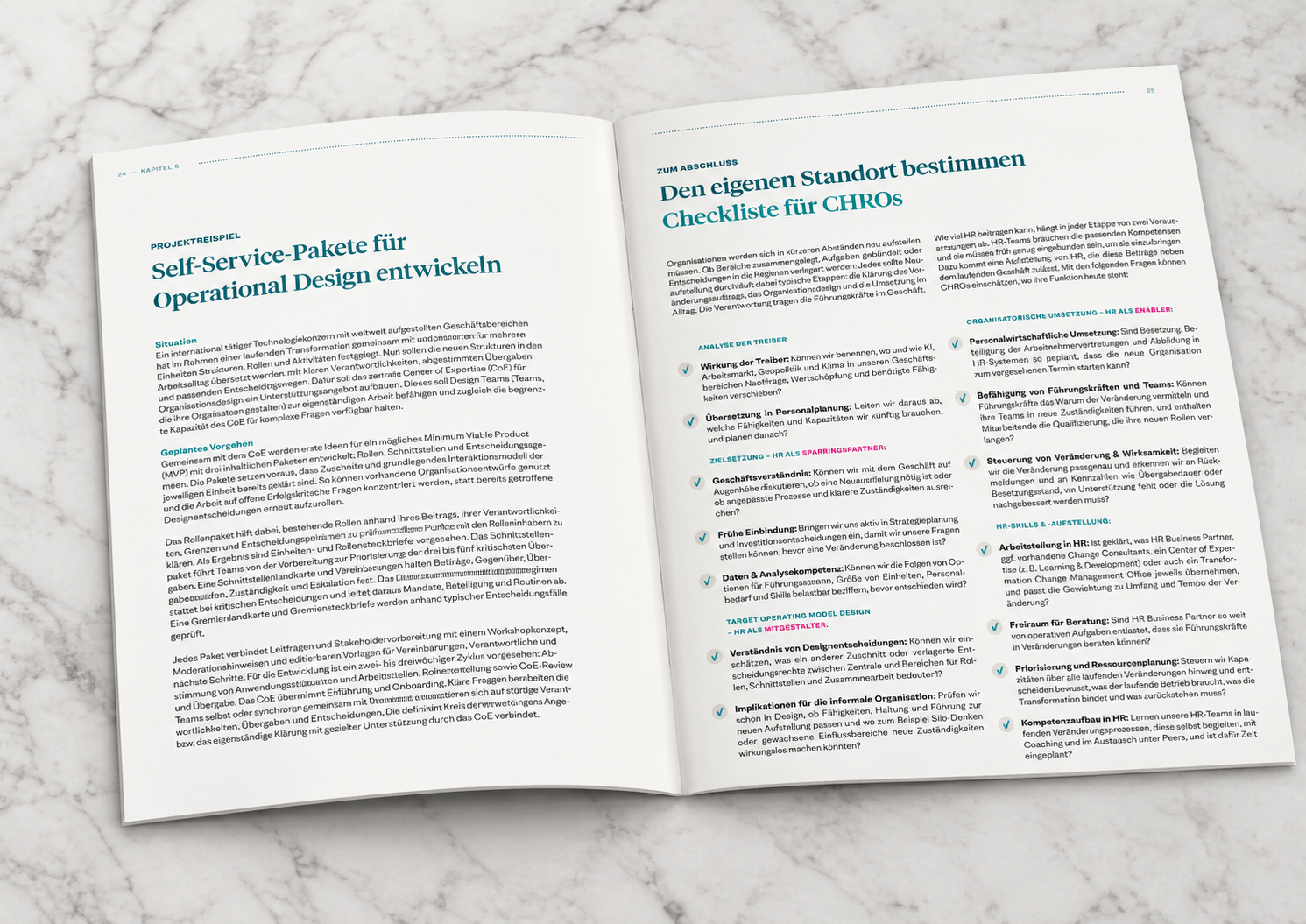
The H2O2 White Paper: Organisation and HR in the Spotlight
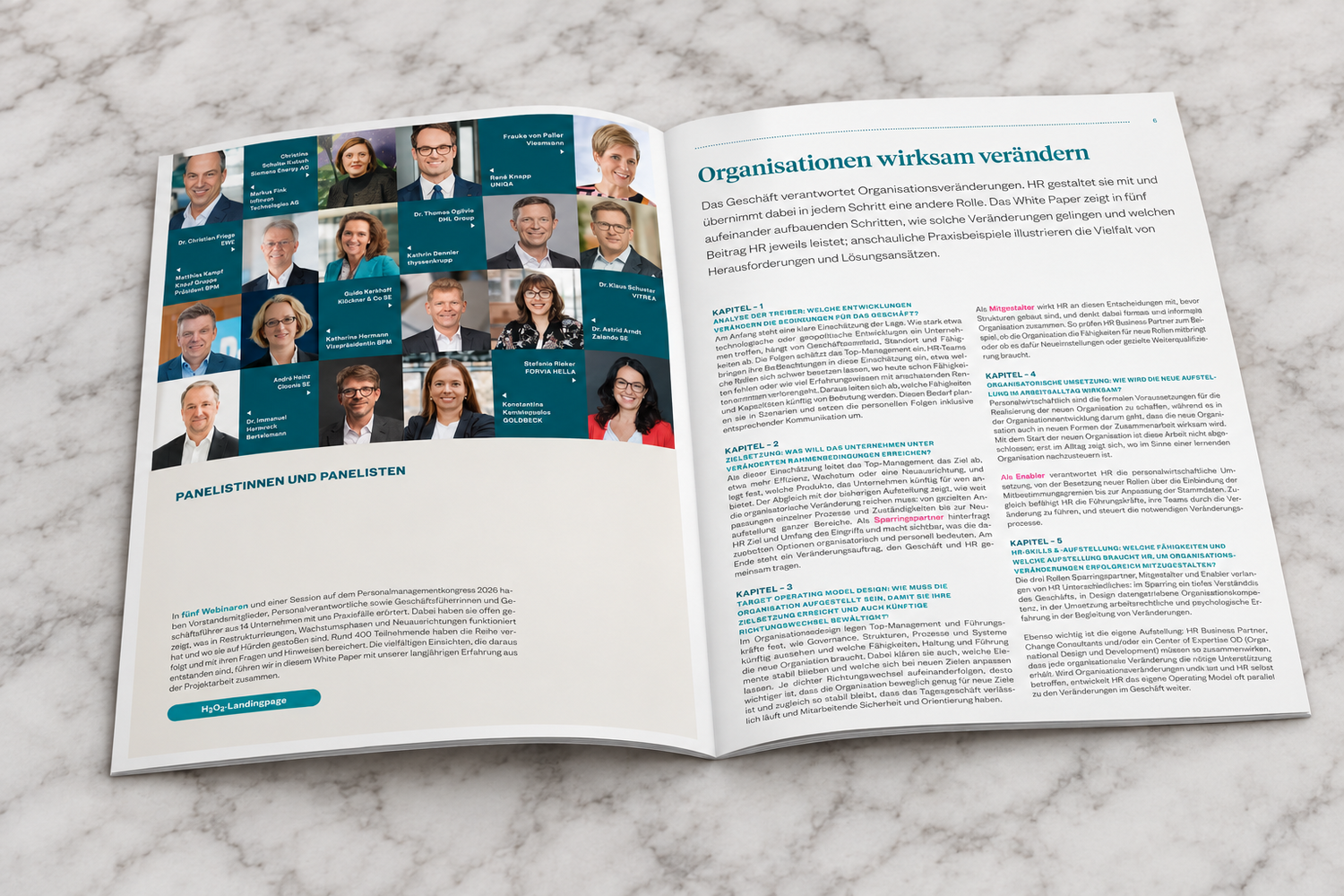
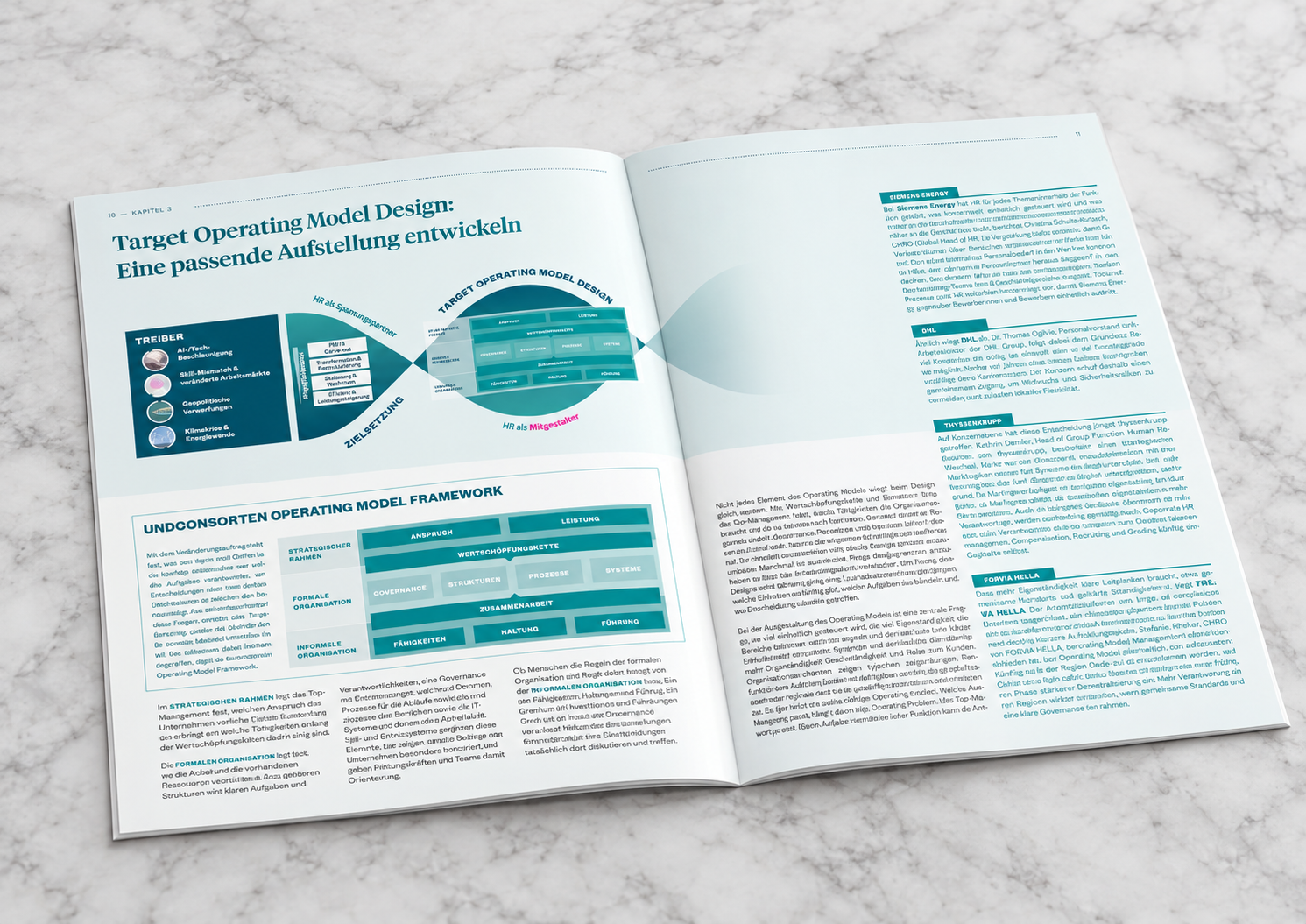
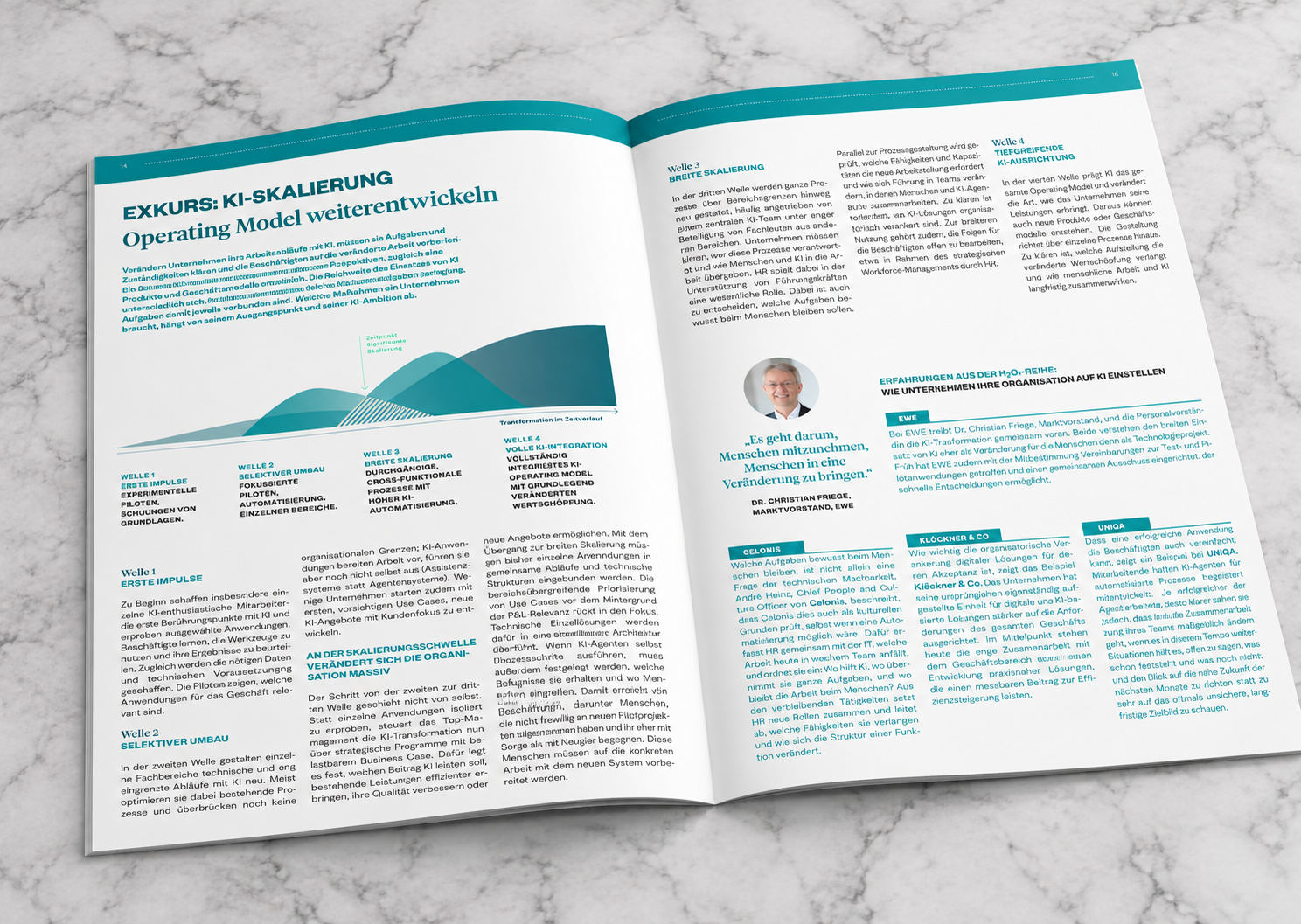
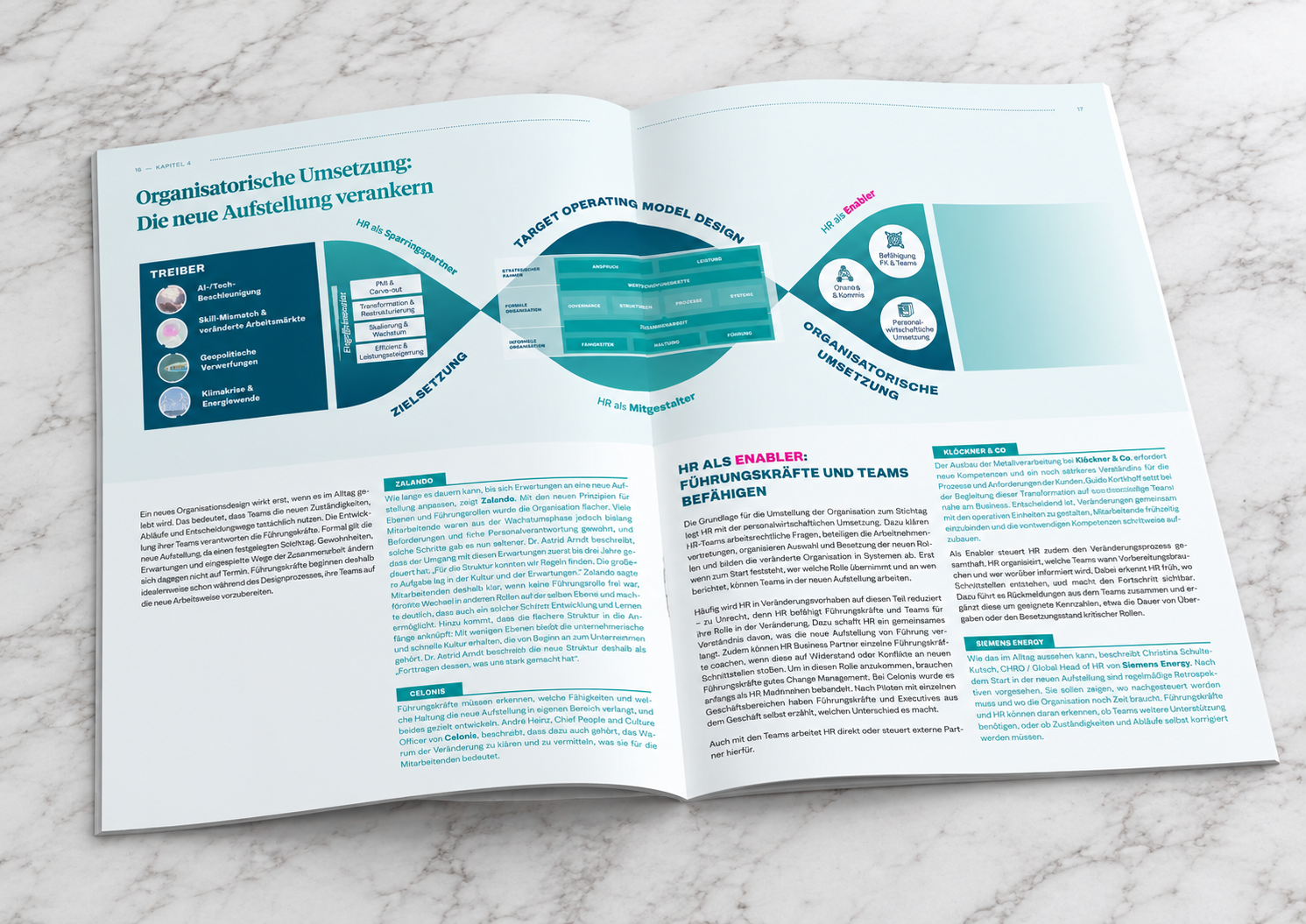
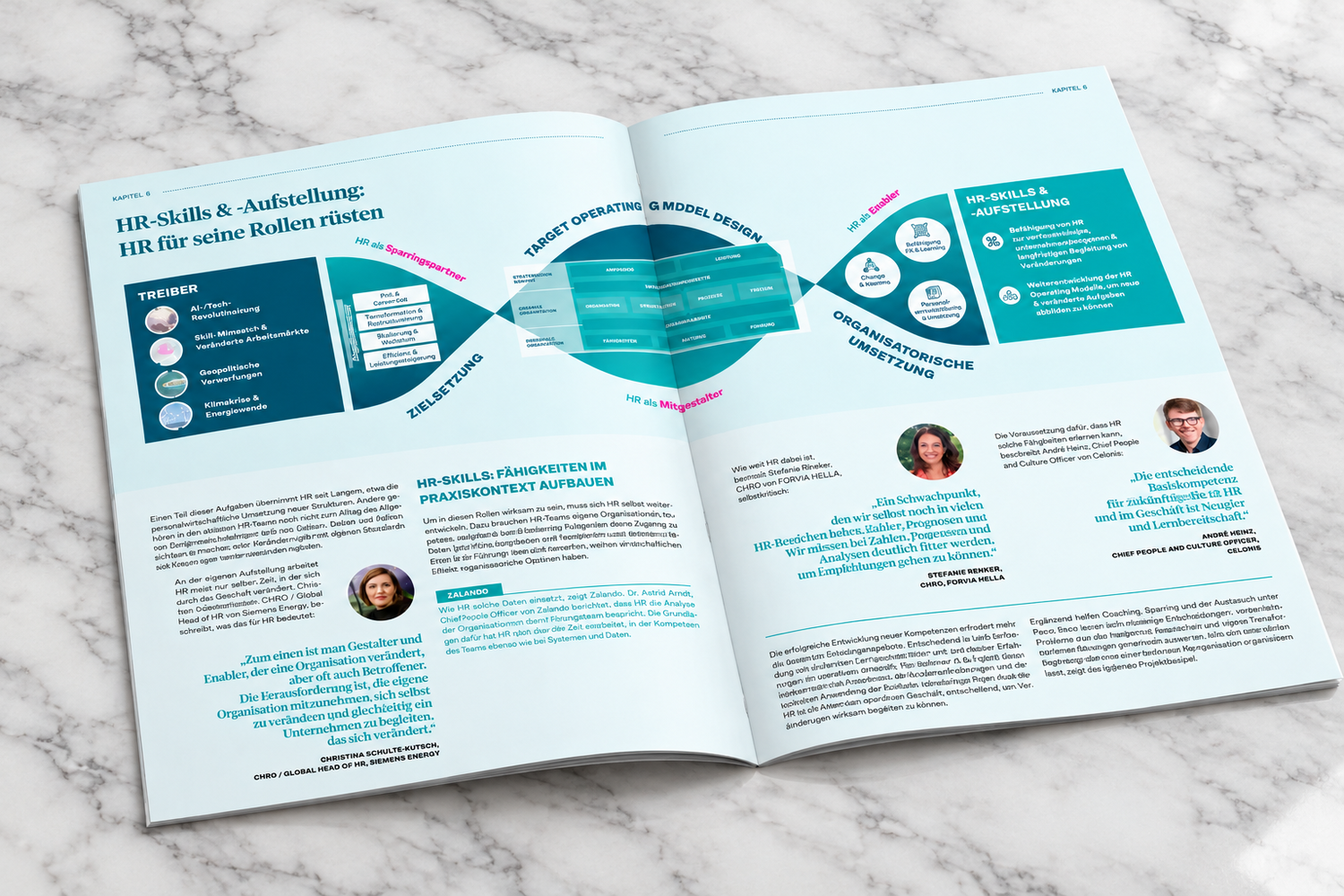
AI, skills shortages, geopolitics and climate risks are forcing companies to restructure their organisations more frequently. This white paper sets out, in five steps, how organisational change can be successfully implemented and the role HR plays in this process. It is based on real-life case studies from board members, HR managers and senior executives at 14 companies.
Why this series of events?
Organisations in the DACH region are under intense pressure. They are having to adapt at an ever-faster pace. Changes are required in ever-shorter cycles – driven by costs, new technologies such as AI, or shifting markets.
HR plays a crucial role in this: as a sparring partner, a co-creator and an enabler. But how can HR successfully fulfil these roles effectively? How can the operating model be made fit for the future?
As for the series H2O2has delivered:
- Mapping: Established a shared understanding of the operating model and organisational development
- Reflection: Real-world business scenarios werediscussed with high-profile CHROs and experts from leading DACH companies
- Inspiration: A practical toolkit and best practices for your day-to-day work – practical and immediately applicable

HR professionals play an active role in three key phases of holistic organisational design, each in their own way.
Five-part webinar series – from strategy to implementation
In exclusive panel discussions, CHROs and CxOs from renowned DACH companies (DAX, SMEs, hidden champions), as well as experts from academia and the consultancy sector, discussed how HR can play an effective role in organisational design.
Once you have successfully registered, you will receive:
- The white paper containing all the insights from the series
- Summaries and recordings of all sessions
- Information on further resources relating to organisation and HR
ORGANISATION IN THE SPOTLIGHT (Webinars 1–3)
Focus: Pressure for change and the various facets of organisational design and development
#W1: Organisations in transition
There is no such thing as the ‘right’ operating model. Only the right one for the right moment.
In the kick-off webinar, we discussed what this means in concrete terms together with Christina Schulte-Kutsch (Siemens Energy) and Markus Fink (Infineon):
- Following massive market growth and increased volatility, Siemens Energy has realigned its operating model to focus on greater flexibility, accountability and a new approach to leadership.
- With its ‘Spirit’ programme, Infineon has focused on three key levers: more ambitious targets, clarity in roles and responsibilities, and faster decision-making processes – and HR has led the way as a pilot.
- HR is most effective when it fulfils a threefold role: acting as a sparring partner, shaping the future and implementing change – all at the same time, not one after the other.

#W2: Operating Model Trends
AI, technological acceleration and new value creation models
AI does not simply change how we do things. At its core, it changes how we work. In the second webinar, we discussed with René Knapp (UNIQA), Frauke von Polier (Viessmann) and Dr Christian Friege (EWE) what this means in concrete terms:
- EWE has introduced AI into its written customer communications – and learnt that a good system alone is not enough. If you fail to engage the people who work with it, you’ll achieve efficiency on paper, but not better customer satisfaction.
- UNIQA automated a claims process in Hungary – and, as a side effect, achieved a customer satisfaction rating of 4.95 stars. This example shows that the effects within interconnected systems cannot be fully planned. Iteration trumps a master plan.
- Viessmann does not view AI as an efficiency tool, but as a colleague with an IQ of 500 to improve the quality of decision-making, in line with the motto: ‘Human Led, Agent Powered’.
- The leap from isolated use cases to genuine scaling is not a technical hurdle. It is a leadership decision that requires courage.
- HR has a fundamental role to play here: thinking through how work needs to be reorganised – and empowering the leadership system to drive this transformation.

#W3: Organisational flexibility as a basis
Operating Models: Balancing Adaptability and Stability
In the third webinar, we discussed with Kathrin Dennler (thyssenkrupp), Dr Thomas Ogilvie (DHL) and Dr Klaus Schuster (VITREA) how organisations balance constant change with operational stability:
- Thyssenkrupp is transforming itself from an integrated group into a financial holding company with autonomous business units. It is not a question of stability or change, but of striking a deliberate balance depending on the business unit.
- DHL, with 600,000 employees, navigates a wide range of completely different logistics disciplines. The focus is on keeping the company ready for change whilst ensuring staff are on board – through consistency in core elements (brand, culture, talent) and flexibility in decision-making processes.
- As a carve-out, VITREA is undergoing a comprehensive organisational transformation, whilst simultaneously serving 14,000 staff and 200,000 patients annually. The focus varies by level: management aims for transformation, whilst local clinics focus on operational stability.
Conclusion: Consciously shape this tension rather than resolving it. HR is most effective when it actively helps to shape this ambidexterity in strategy, formal organisation and corporate culture.

Expert Session at the 2026 Human Resources Management Congress

Facing dual challenges, taking a clear stance: How HR supports (AI) transformations whilst making itself AI-ready
- HR as a driving force behind company-wide AI transformation: refining objectives, embedding change, creating the organisational conditions for scaling
- Practical insights: Where is AI changing the operating model – and which processes offer the greatest potential?
- HR under pressure: How can the HR function make itself AI-ready to deliver credibly and free up capacity for the transformation?
- Interactive and on an equal footing: Participants contributed their own case studies and discussed together what really works in practice


HR IN THE SPOTLIGHT (Webinars 4–5)
Focus: Organisational implementation and the role of HR
#W4: Empowering Business & HR for Organisational Design and Development
Putting theory into practice: How can organisational competence be permanently embedded in HR and leadership?
In the fourth webinar, we discussed these and the following questions with Dr Astrid Arndt (Zalando), Guido Kerkhoff (Klöckner) and André Heinz (Celonis).
- HR as a sparring partner, co-creator and enabler of the Target Operating Model: What is HR’s role, mandate and scope?
- Methods and tools for practical application: How can HR and leaders effectively shape and implement organisational design and development?
- Practical examples of different change scenarios: from AI-driven transformation and strong growth, through efficiency improvements, to business model realignment.
- Empowering leadership and HR: What skills are needed to ensure that organisational changes do not remain mere concepts, but have a lasting impact?
Conclusion: Organisational competence requires empathy and patience. This involves listening, occasionally adopting a ‘zero-based’ approach to organisations, and understanding change at the grassroots level.

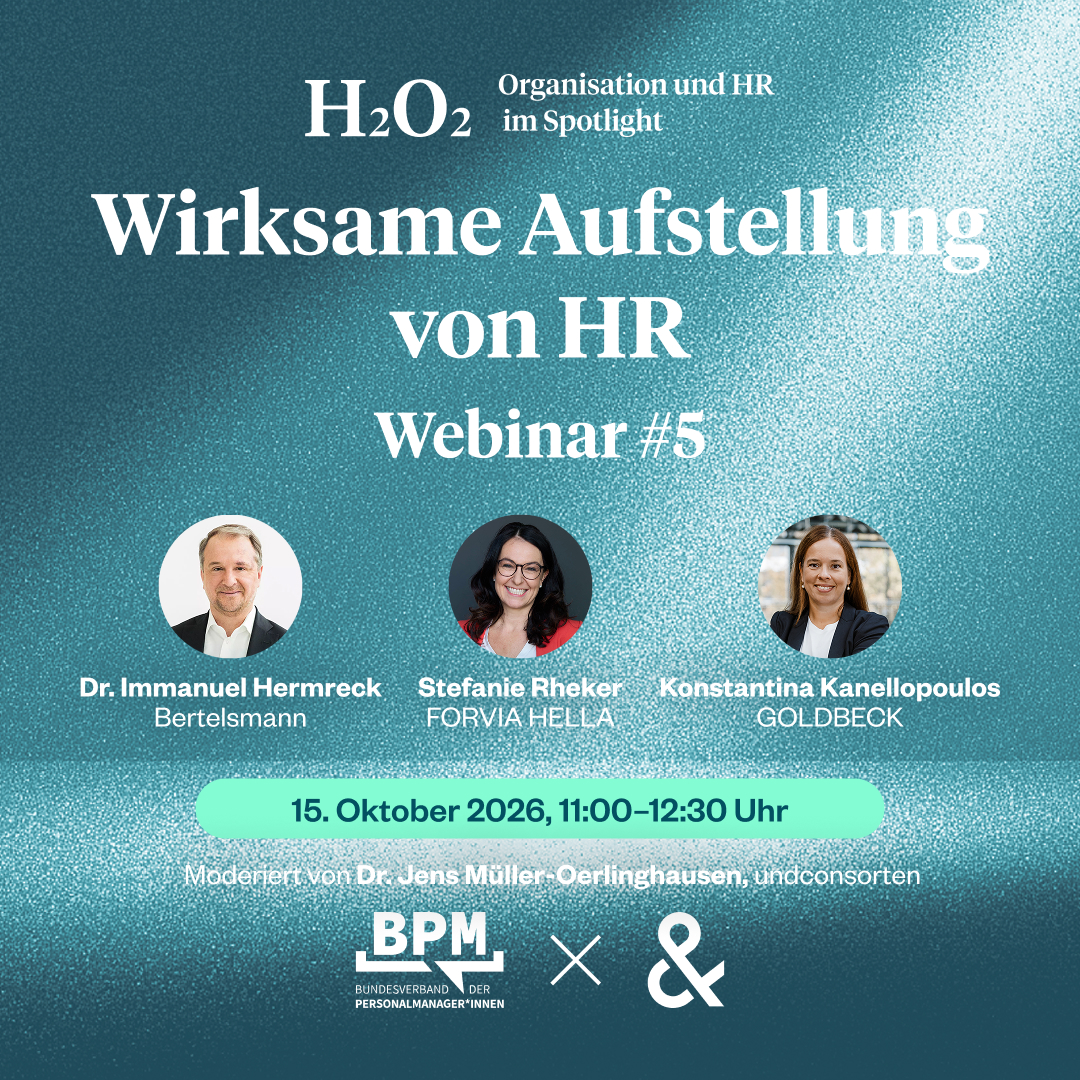
#W5: Effective HR Organisation
Summary: HR TOM, methods and tools for a successful strategic role
In the fifth and final webinar, we discussed the following questions with Konstantina Kanellopoulos (GOLDBECK), Stefanie Rheker (FORVIA HELLA) and Dr Immanuel Hermreck (Bertelsmann):
- Empowering leadership and HR: At Bertelsmann, each level of management first had to identify the current state of affairs when standardising job titles against role profiles. Implementation took place via ‘learning journeys’, supported by local business partners and senior management.
- Practical examples of different change scenarios: Following a merger, FORVIA HELLA shifted responsibility to the business level, with China as the pilot market. GOLDBECK managed a simultaneous restructuring of capacity: downsizing in the core business, expansion in the data centre business.
- Practical tips for a stronger mandate: “Assess fit at management level at an early stage and make consistent decisions.” First, review your own roles and skills (or the future target skills mix). “Don’t be afraid of figures.”
Conclusion: Effective organisational design requires HR to be involved (at an early stage) and clear lines of responsibility. Crucial factors include clear governance, leaders who champion change, and figures as a shared basis for decision-making.
Who are these recordings and white papers relevant to?
This webinar series was and is aimed at:
- CHROs and CXOs
- HR managers and HR business partners
- Organisational developers and change managers
- Managers who support organisational change
- Anyone wishing to develop their organisational skills
What the series had to offer
- Top speakers with great charisma
CHROs and CxOs from well-known DACH companies (DAX, SMEs, hidden champions) as well as renowned experts from business and academia share their experiences. - Practical insights and real-life case studies
Concrete examples and lessons learnt from actual organisational changes – not theory, but real-world practice. - HR toolbox
Brief insightsfor a broader perspective, as well as practical tools and frameworks for your day-to-day work. - Interactive exchange
Q&A sessions, live discussions with the panellists and networking with other HR professionals. - Data-driven insights
Analysis of data and incorporation of participants’ perspectives (e.g. via mini-surveys) to yield relevant insights. - Comprehensive documentation
All findings will be summarised in a white paper. All registered participants will receive access following the webinar series.
The concept: a consistent customer journey
From introduction to consolidation
This webinar series forms part of a comprehensive initiative to strengthen organisational competence in HR. The journey comprises:
1. Kick-off – HRM article
A concise introduction to the topic: the role of HR in organisational development.
2. Discussion & Empowerment – 5–6 webinars + PMK 2026
High-calibre discussion based on various case studies in organisational development. Each panel features 2 CHROs, 1 CxO and experts from the fields of consultancy and academia. Further enrichment through input from participants at the 2026 Human Resources Management Congress.
3. Synthesis – White Paper
Consolidation of the key findings from the entire series. Integration into a broader organisational context. In-depth analysis of triggers and potential solutions for various business scenarios.
Organisers
A joint initiative by:
and the like
A top-tier management consultancy with more than 50 consultants in Germany, Austria and Switzerland. We specialise in developing excellent organisations in line with our purpose: “Inspiring people to grow and build better organisations.” Our clients particularly value our expertise in teamwork, communication and the ability to deliver results. We work as equals, from the board of directors right down to the operational level.
BPM – Federal Association of HR Managers
The leading professional association for HR managers in Germany, with over 5,000 members. BPM stands for expertise, networking and innovation in human resources management and is committed to the professionalisation and further development of the HR community.
The BPM organises Europe’s largest HR congress, the annual Human Resources Management Congress in Berlin.
Get the insights from the series now
The webinar series has now concluded. We have summarised the key takeaways from the five webinars and the panel discussion at the HR Management Congress in our white paper. Register for free to receive the download link directly by email.