
Why leadership today means above all making decisions
Uncertainty has become the background noise - in society, politics and business. For companies, this means that orientation comes less from plans and more from decisions.
And this is precisely where leadership beyond rules begins: Where situations are new, complex or contradictory - and where policies no longer "automatically" provide the answer. Leadership then does not mean working through processes neatly, but interpreting, weighing up and taking responsibility.
It is precisely in these situations that leadership boils down to one central action: making decisions.
At its core, decision-making means: Enduring ambiguity, providing direction, taking responsibility. In complex environments, "all" relevant information is rarely available to make a decision with complete certainty. The search for it quickly proves to be a bottomless pit: more data, more stakeholders, more dependencies - but rarely the moment when it is fully analysed.
This is precisely why we need leadership that can make the leap: from collecting information to assessing risks - and from there to taking responsibility and making decisions.
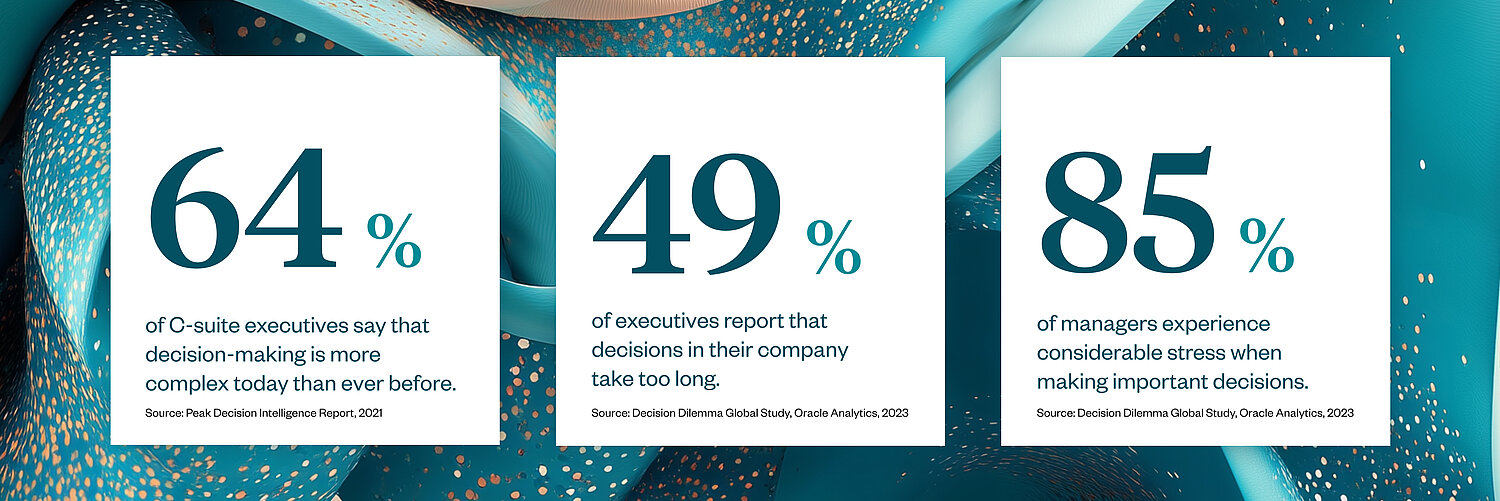
And this responsibility is real - for better or for worse. Those who make decisions are betting on an option and accept that they and the company can also lose. This is not an abstract risk, but a personal challenge for managers: 85% of managers report having been under considerable stress in connection with important decisions; just as many regret at least one decision made in the past year. Decision-making is therefore not only cognitively demanding, but also physically and emotionally stressful.
This is where the central everyday dilemma of modern leadership arises: the cost-benefit distribution of a courageous decision, which is experienced as asymmetrical. While the potential benefit of a decision is shared organisationally and has many winners, the risk of failure is felt to be more concentrated on the decision-maker. This can lead to hesitation, as wrong decisions are visible and non-decisions are rarely clearly attributable.
Taking responsibility is therefore not neutral, but burdensome. It means being exposed, enduring uncertainty and accepting an asymmetrical distribution of benefit and risk. This is precisely what makes decision-making in day-to-day management so challenging - and explains why risk aversion and procrastination are so widespread.
Interestingly, external pressure can partially resolve this dilemma. When markets collapse, costs explode or old business models clearly no longer work, the scope for decision-making shrinks. Options disappear, radical simplifications become necessary - and not making decisions is suddenly no longer an option.
The Covid-19 pandemic has clearly demonstrated this: In a very short space of time, decisions were made that were previously considered unthinkable or too risky. When decisions have to be made, organisations can decide. Responsibility becomes more collectively legitimised in such situations - the situation is "forcing". However, when the external pressure subsides, the old mode often returns.
This is precisely the real leadership challenge: to systematically enable decision-making power not only in exceptional circumstances, but also during normal operations. The next step will show why this is so difficult in everyday life.
How managers and organisations increase decision-making power
Methodological levers: simple logic instead of perfect certainty
Information overload is increasingly leading to analysis paralysis - especially where many people involved have good reasons to "briefly" check decisions further, to secure them or to postpone them. What begins as diligence often ends in delay.
Current studies paint a clear picture: 64% of C-suite executives state that decision-making is more complex today than ever before. Around 49% report that decisions in their organisation take too long, and many admit to having postponed major business decisions until the window of opportunity had passed. At the same time, 54% say they regret a major business decision afterwards (Decision Dilemma Global Study, Oracle Analytics, 2023).
The figures make it clear that the problem is rarely a lack of analytical ability - but rather the lack of a clear decision-making logic that helps to consciously reduce complexity and find the leap from information to decision. Two simple principles are helpful:
- One-way vs. two-way doors (Bezos, 2016): Thoroughly review irreversible decisions (e.g. build factory); make reversible ones (e.g. test feature) faster and readjust.
- 70% rule (Bezos, 2016): For many decisions, a resilient level of information is enough - waiting for 90% makes you too slow.
This turns decision-making into a process: hypothesis-based, risk-balanced, adaptive - instead of perfect.
Structural levers: clarity about who decides
Even with clear decision-making logic, decision-making often gets stuck in practice. Where responsibilities, decision-making rights, or accountabilities are not clearly defined, uncertainty and paralysis can be shifted to formal issues—decisions are postponed without being openly rejected.
Who is allowed to decide what - and who is ultimately responsible? If this is unclear, committee loops, hedging rounds and delays occur. 40% of managers surveyed cite complex organisational structures and unclear role requirements and responsibilities as the main causes of inefficiency - which significantly delays processes, including cross-functional projects (From shock to opportunity, McKinsey, 2023).
Consequence: Fewer committees, more ownership. A clear decision-making design reduces frictional losses - and relieves managers because not every decision has to be "political".
Cultural levers: making responsibility sustainable
Structure and method bring speed - but without a sustainable environment, the personal risk remains high and risk aversion wins. The cultural side must therefore also be taken into account.
Three aspects are crucial:
- Psychological safety & learning culture: blame cultures slow down problem solving; teams with high safety decide faster and better (Gallup 2024).
- Disagree & Commit: Allow contradiction - and act as one once the decision has been made.
- Clear separation of levels: A reflected, risk-balanced wrong decision is different from negligence. Personal risk ≠ business risk - and this distinction must be tangible in everyday life.
What good leadership achieves through decisions (and why speed counts in the end)
When leadership shapes decisions well, three effects arise:
Orientation & prioritisation
Leadership creates clarity: Where are we heading? What is really important now - and what can wait? This sets priorities and creates a framework in which teams can make decisions more independently.
Risk and conflict management
Good leadership consciously assesses risks (including the option of "not deciding") and makes tensions negotiable: listen to positions, make conflicts visible - and decide anyway.
Speed as a competitive factor
This is where speed becomes a hard lever for success: markets penalise slowness because windows of opportunity close quickly. A large proportion of strategic opportunities disappear within a short period of time - and not making decisions becomes a risky decision in itself (missed opportunities, lost time).
The courage to make faster decisions pays off. Research shows that quick decisions are not a risk but an advantage in dynamic markets. Organisations that can decide and readjust quickly secure market opportunities more often, react more quickly to changes and remain competitive. Hesitation, on the other hand, costs time, options and often market share (McKinsey Quartely, 2023). Quick decision-making creates clarity, orientation and utilises opportunities.
Talk to us.
Do you have any questions or are you interested in exploring a possible collaboration with undconsorten? Get in touch with us - we will help you further.