AI transformation
Where do companies really stand with AI transformation?
Many companies have launched AI initiatives. However, most of them have failed to make a measurable impact on costs, growth or their business model. Why is this - and what separates companies that are really making progress from those that are stuck in pilot mode?
What is AI transformation?
AI transformation refers to the structured process by which companies not only utilise artificial intelligence as a stand-alone tool, but also integrate it as a strategic lever in their value creation - with a measurable impact on efficiency, quality and growth. It goes far beyond the use of language models or automation pilots and requires changes in the operating model: governance, structures, processes, systems, skills and leadership.
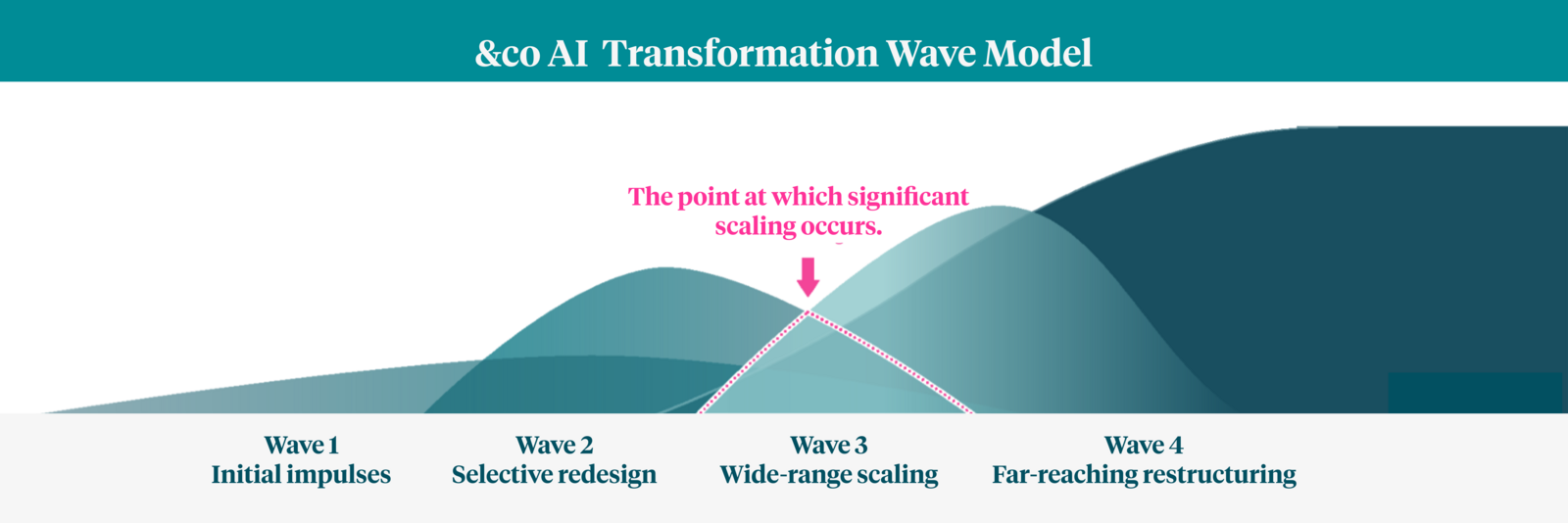
The four waves of AI transformation
Companies are at different levels of maturity. A wave model helps to categorise them:
Wave 1
First impulses:
AI has arrived, but often still on a small scale. Enterprise GPT solutions, isolated pilots, individual productivity gains - but no measurable business effects.
Wave 2
Selective redesign:
Initiatives arise within individual areas. Automation remains vertically and functionally limited. There is no company-wide strategy.
Shaft 3
Broad scaling:
Entire process chains are being rethought. Comprehensive ownership and governance enable measurable bottom-line effects.
Wave 4
Far-reaching reorganisation:
AI changes business models and creates top-line impact through new products, markets and customer experiences.
Impulse AI and automation | Lucas Brosi, undconsorten
Extract from our H₂O₂ webinar 2: Operating model trends (Please not that the webinar was held in German.)
Most companies are stuck in wave 1 or 2. Lucas Brosi provides insight into what is preventing the leap to scale, why AI transformation is more difficult than traditional organisational transformation and what role HR plays in this.
Why AI initiatives often do not end up in the P&L
Almost all companies have launched AI initiatives. They typically start with text generation, translation, summaries and automation pilots in isolated process steps. This creates visibility - but not yet measurable business effects.
Two structural limitations occur regularly:
- Static, uncoupled database: A strategic data architecture as a basis for broader AI use is missing.
- Processes that are not geared towards AI: Those who embed AI into existing processes retrospectively instead of rethinking processes from the ground up are not utilising its potential.
AI is introduced on a tool-driven basis, not strategically. The result: individual productivity gains, but no measurable business effect.
From pilot to effect: what makes the difference
Bottom-line effects need larger levers
Individual automations save time in the respective function. However, they do not change the cost structure or personnel requirements to any relevant extent.
A real bottom-line effect only arises when entire process chains are rethought - not a single step in accounting, but the entire quote-to-cash process, which includes sales, legal, account management, finance and product. Such initiatives go beyond the scope of individual functional areas and require ownership at Management Board level.
Top-line impact goes beyond efficiency
The dominant perspective on AI is efficiency: cutting costs, speeding up processes, reducing FTEs. This is understandable - but those who view AI solely through the lens of efficiency are missing out on a large part of the value potential.
Transformative impact arises in three dimensions:
- Efficiency: Faster processes, lower costs
- Quality: Better decisions, fewer errors, faster iterations
- Innovation: New products, business models and customer experiences that would not be economically feasible without AI
The real brake: the operating model
Why do so many companies get stuck with small, isolated use cases? The answer rarely lies in the technology. It lies in the operating model.
AI transformation affects all formal and informal building blocks of an organisation. There are typical brakes lurking in each of these building blocks:
- Governance: there is a lack of clear responsibilities, decision-making logic and steering committees. As long as no one prioritises and steers across departments, AI transformation remains a project topic rather than a matter for the boss.
- Structures: Functional silos prevent AI potential from being realised where it is greatest - at the interfaces between departments.
- Processes: AI must be thought of as AI-first from the ground up instead of being embedded in existing processes retrospectively. Those who consistently rethink key business processes will tap into significantly greater leverage.
- Systems: Without scalable, integrated systems, AI remains a stand-alone tool instead of a driver of value creation.
- Collaboration: AI transformation can only succeed where self-control, trust and continuous development are a reality.
- Skills: Without targeted skills development - at management level and across the workforce - the potential remains unutilised.
- Attitude: Scepticism and risk aversion slow things down. The cultural patterns that characterise thinking are the most invisible but most powerful brake.
- Leadership: AI transformation does not need a perfect strategy - it needs leadership that provides orientation and can withstand uncertainty.
When AI transformation is the right next step - and when it is not
AI transformation is the right focus if:
- Your organisation has completed initial AI pilots and is planning the next step towards measurable business impact
- AI initiatives are not having the expected impact on P&L despite the effort involved
- Cross-divisional AI scaling fails due to governance or structural issues
- The management level has not yet defined the strategic framework for AI
AI transformation is not (yet) the right focus if:
- Your company is still in the process of fundamental digitalisation - other priorities take priority here
- There is no willingness to fundamentally change processes and structures
- AI is treated exclusively as an IT topic - without the strategic involvement of management
AI transformation vs. AI implementation
AI implementation refers to the technical introduction of AI tools and systems into existing processes. It is necessary, but not sufficient.
AI transformation goes further: it changes how an organisation delivers its services - in terms of governance, structures, processes, skills and attitude. It is not a project with an end date, but a continuous development process.
The difference is not academic. It explains why organisations achieve very different results with the same tools.