
Ambition, process selection and the business case: How AI benefits translate into results
Time savings are not the same as an impact on results. Between the two lie organisational boundaries, incentives and measurement issues. Anyone taking the step towards scaling up therefore needs a vision, a deliberate and focused selection of processes, and a business case that takes the incentives of those involved seriously.
Three reasons why benefits fail to materialise
Vertical rather than horizontal. AI potential arises where processes cross departmental boundaries: an agent who manages a request from start to finish saves time across three departments, but not enough in any single one to make a noticeable difference. However, responsibility, budgets and targets are organised along functional lines. Each function optimises for itself, and nobody feels responsible for the process as a whole. Cross-functional AI requires cross-functional ownership: one person responsible for the end-to-end process, shared objectives for the departments involved, and a budgeting approach that allocates benefits to where they are generated.
Incentives. Anyone who identifies potential efficiency gains within their own department risks their budget and their team. So calculations are made cautiously, and the steering committee ends up with estimates that do no one any harm, but do not convince anyone either. This is not a question of character, but a predictable reaction to the question of what happens to the potential that is unlocked. Those who answer this question in advance will receive more honest figures.
Measurability. Efficiency can be quantified: hours, cases, lead times. Better quality, faster decisions or a better customer experience cannot be quantified so easily, particularly as the metrics for many processes are limited. Often, there isn’t even a reliable baseline. The result: business cases are based on what can be measured, and that is almost always efficiency.
Three dimensions instead of one
A viable AI vision should therefore identify three dimensions as equally important.
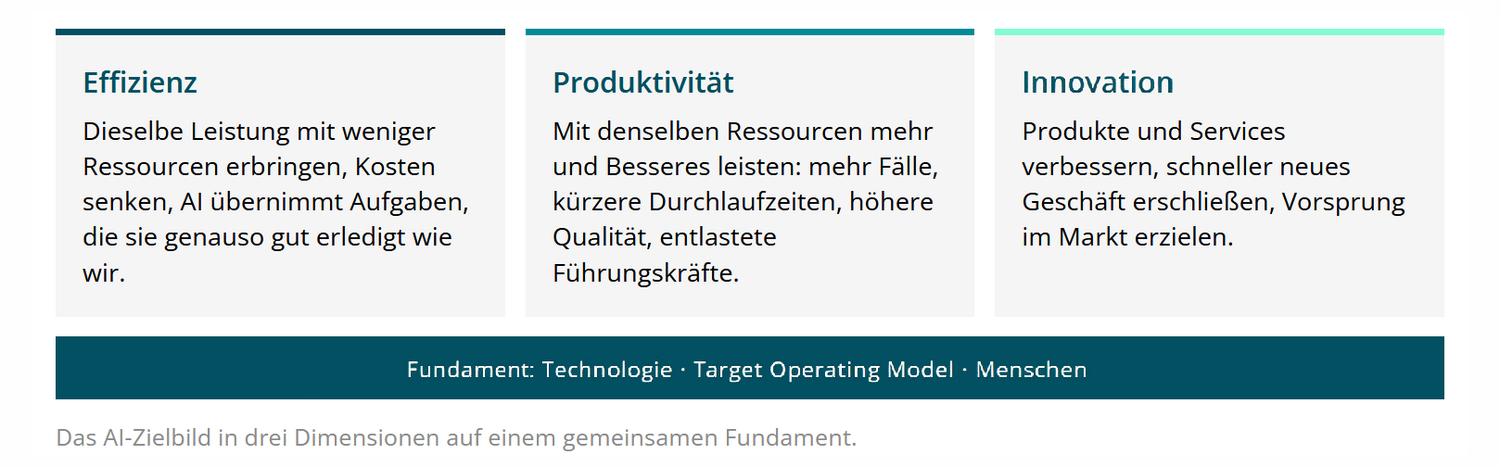
In most business cases, the first dimension takes precedence because it is the easiest to express in euros. The second is frequently overlooked, even though in practice this is where the lion’s share of the benefits lies: audits that are currently carried out on a random basis but will be comprehensive in future; requirements that are communicated more clearly at the start of a process; and turnaround times that customers actually notice. The third dimension often remains a mere declaration of intent because it sounds abstract and is difficult to quantify in advance. It therefore needs its own dedicated processes within the programme; otherwise, it is easily lost sight of. Those who seek only efficiency usually find nothing but efficiency.
Which process first?
The choice of the first processes determines more than just the initial business case. It sends a signal throughout the organisation and determines who gains the experience. An assessment based on several criteria has proven effective – here is an overview of the six most prominent ones:
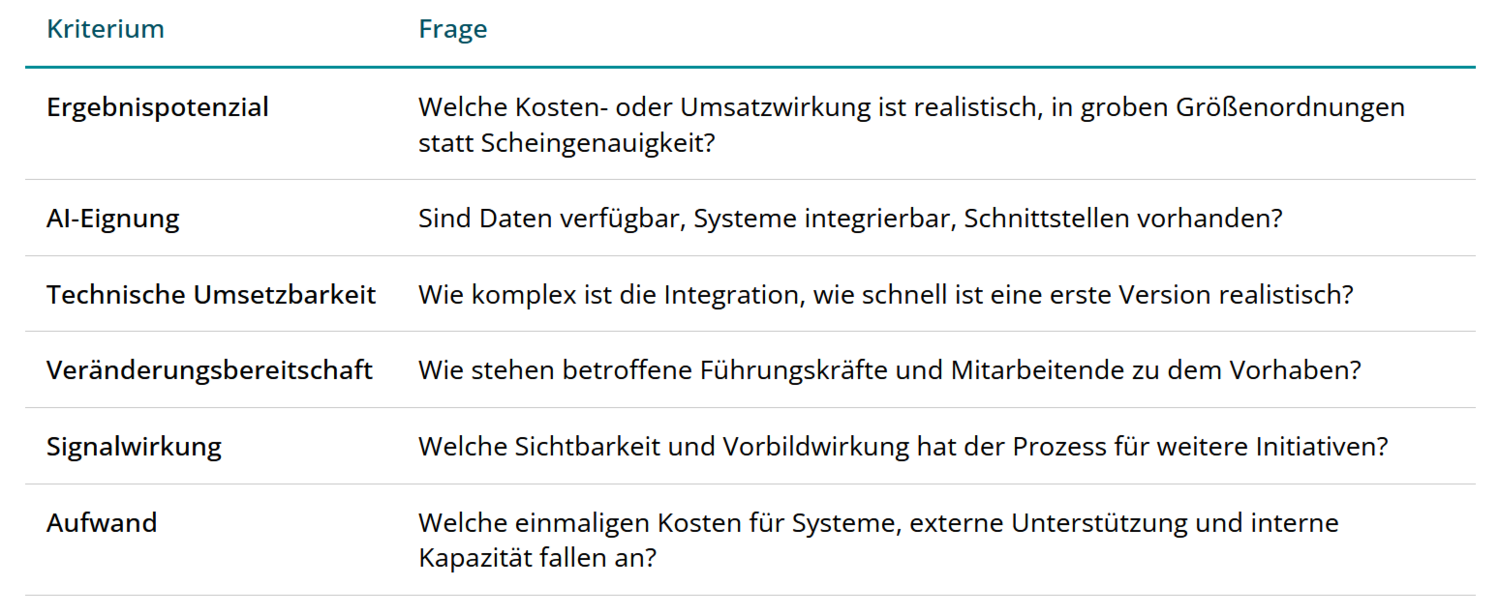
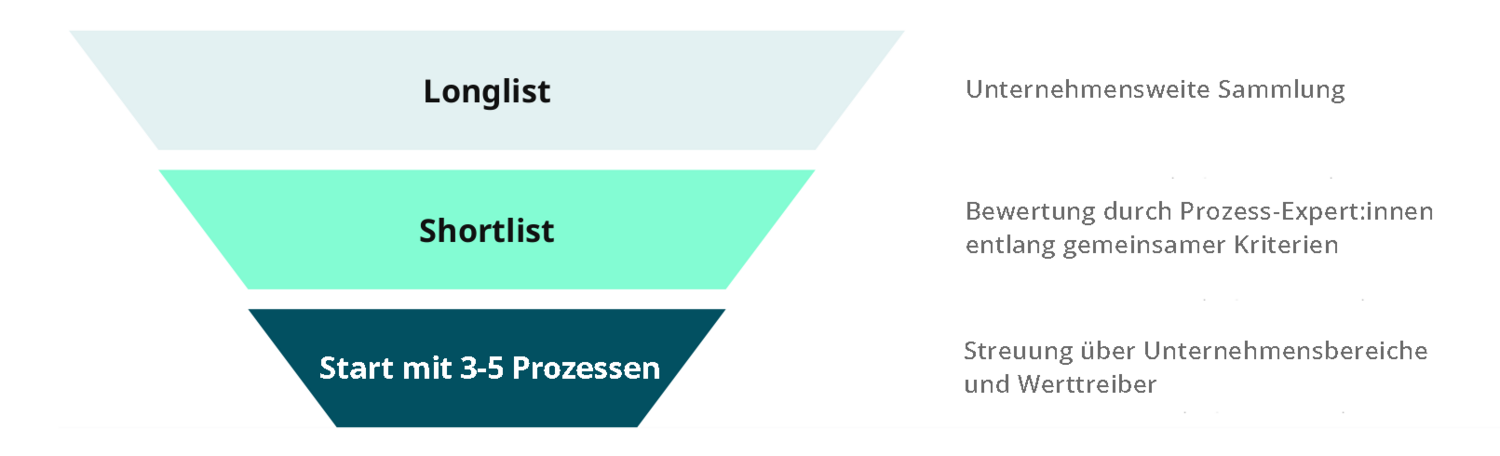
Added to this are balancing rules designed to prevent the programme from becoming one-sided: at least one process per business segment, so that the experience is not confined to one corner of the organisation; and not just processes that contribute to efficiency, but at least one that is primarily aimed at productivity or innovation. The process involves moving from a longlist, through an assessment by process experts, to a shortlist and finally to three to five pilot processes. For most organisations, managing more parallel processes at this stage is difficult to cope with.
What sets the undconsorten approach apart?
undconsorten combines the scaling of AI with a clear ambition, a deliberate selection of relevant end-to-end processes and robust business cases. We assess benefits not only in terms of efficiency, but equally in terms of productivity, quality, customer experience and innovation potential – and to this end, we establish cross-functional ownership, appropriate incentives and transparent decision-making processes. In this way, the time freed up does not remain untapped potential, but is translated into measurable results, improved performance and sustainable value delivered by AI.
The business case on the cusp
Four rules have proven effective for the business cases of the first genuine end-to-end processes.
- Assess the effects per process, not per cost centre. This is the only way to reveal what an agent-based process achieves across departmental boundaries.
- Report impacts separately – that is, cost effects, productivity gains, quality and revenue impacts, staffing effects and transformation costs – each on its own. A business case that squeezes everything into a single figure invites negotiation over the figure rather than the substance.
- Estimate the degree of implementation honestly. In our view, this is the most critical lever. Time freed up only translates into results if someone decides what to do with it: redeployment to other tasks, avoiding new hires or job cuts. Without this decision, it usually remains merely a time saving.
- Clarify in advance within the steering committee what will happen with identified potential. Where this question remains unresolved, divisional managers tend to be cautious in their calculations. Where it has been clarified – for example, through a transitional rule governing the use of freed-up capacity – the figures become more robust. We describe who is responsible for this clarification and how a steering committee might be composed for this purpose in ‘AI Transformation: Who is responsible for what when AI scales?’
Key questions for the steering committee
Does our vision give equal weight to efficiency, productivity and innovation, and are there processes in place within the programme for each of these areas?
Who is responsible for our new processes across departmental boundaries?
Do we assess the impact on a per-process or per-cost-centre basis?
Do the divisional managers know what happens to identified potential?
What can we do with this process that we could not do before?
Let’s discuss:
Where do you see the benefits getting held up: at departmental boundaries, with incentives, or with measurement? We’d be happy to discuss this with you.