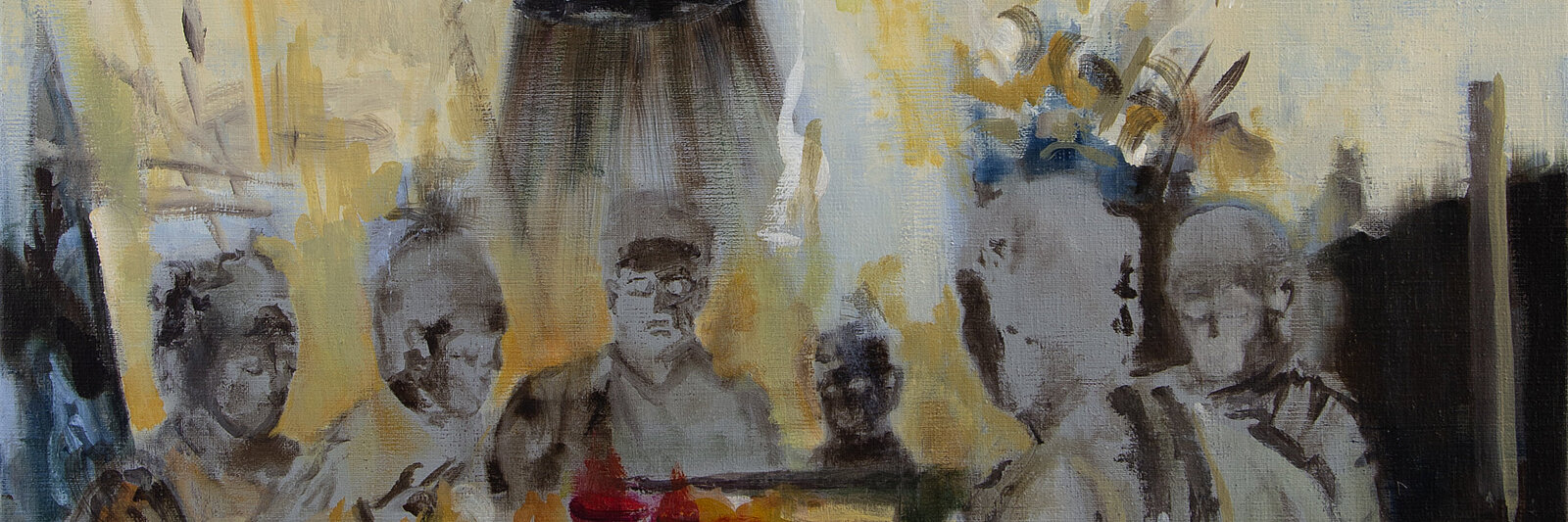
From distance to meaning
History, destruction and reflection in the work of Uwe Wittwer
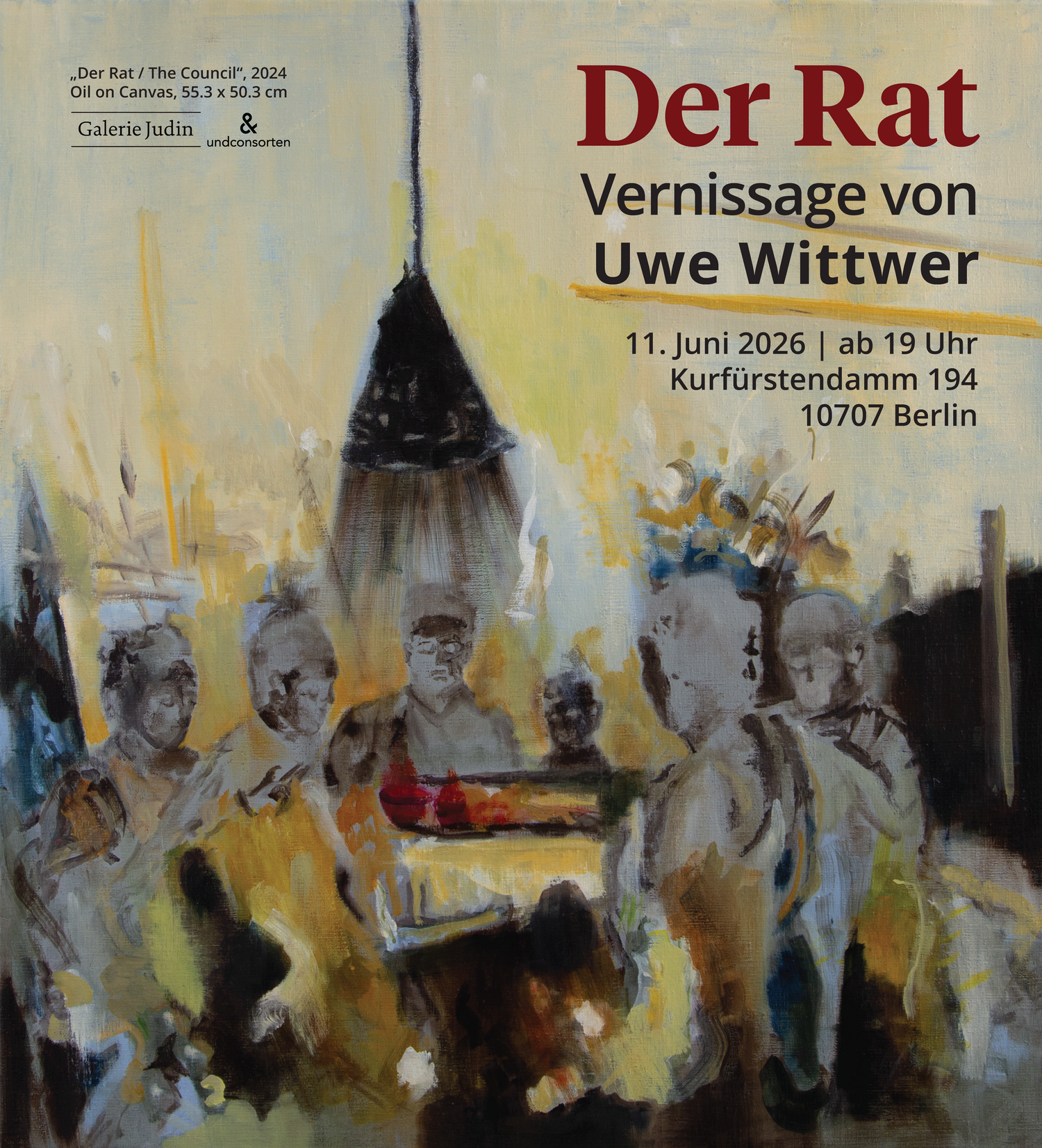
Uwe Wittwer is one of those artists whose works are particularly accessible at second and third glance. His paintings revolve around ruins, theatres of war, the colonial gaze and historical ruptures - not as an immediate reaction, but as the result of reflection. In the run-up to his exhibition in our rooms*, we spoke to him about his path from abstract to figurative painting, about family influences, dealing with destruction and the question of why art has its greatest impact precisely when it is distanced from history.
undconsorten: Dear Uwe, thank you very much for taking the time to talk to us today. How do you develop as an artist? How do you find your vocabulary, your technique and what is your personal development?
Uwe Wittwer: In the early 80s I was strongly anchored in non-representational painting, influenced by the American expressionists such as de Kooning. At that time I had a strong interest in abstract art, but over the years my work began to change. One of the things that influenced me a lot was my close relationship with Ulrich Loock. He had organised his inaugural exhibition as director of the Kunsthalle Bern in 1986 with Gerhard Richter, which was in a way a revival experience for me.
From 1989 onwards, when I came to London on a scholarship, I started to explore new artistic paths. There I got to know artists like David Hockney and Francis Bacon, whose works made me realise that you can also express a certain topicality in figuration. That's why I actually describe everything I created before 1989 as my early work. The works after 1989 became increasingly figurative and dealt with themes such as destruction, warships and ruins in a mixture of provocation and first attempts at figuration. My exhibition at the Kunsthalle Bern in 1991 was the starting point for me to reach a wider public. At the same time, there were exciting parallels with artists of the same age, such as Luc Tuymans, who were dealing with the same question: What can painting still achieve today?
&co: Did these figurative motifs come from the conscious mind, the subconscious or are there biographical references?
UW: The motifs come mainly from the conscious mind. They are the result of a long creative process in which I constantly try to find new perspectives. However, there are also biographical influences. My father's story plays an important role. He fled Berlin with a Swiss passport and carried the experiences of the war within him, which also prevented him from pursuing the artistic career he had actually aspired to. These experiences and the speechlessness associated with them influenced me greatly, especially the themes of destruction and memory, which crop up again and again in my art. My work is strongly characterised by these biographical references, but it is less about depicting personal memories and more about dealing with universal themes that affect many people.
On the advice of a psychoanalyst friend and inspired by Wim Wenders' "The Sky Over Berlin", I travelled to Berlin together with my father in 1988, and that was fantastic, a real initial moment.
&co: How did you experience your father?
UW: Like a young kid (laughs). It was a very formative experience, because although we had some tensions beforehand, this trip was a new beginning for both of us. In Berlin, he showed me many things I didn't know, we made contact with his family on both sides of the Wall, which was still standing at the time, and I began to see him from a different perspective. This trip was a very important experience not only for me, but also for him, which changed our relationship and influenced me in my artistic work.
&co: In a way, were these the ruins through your father's eyes that you then began to paint?
UW: I don't know exactly. As a child, I couldn't even imagine that it had been a total obliteration of entire buildings and, to a certain extent, the entire city. In this respect, there was something about taking a closer look, about coming to terms with human destruction, even beyond Berlin. The ruin is also an ambiguous (eternal) motif in art history.
&co: What does it do to you to see such ruins in Syria or Ukraine today, against the background of your early involvement with the subject?
UW : Dealing with destruction is still a central theme in my art, but a certain distance has developed. Processing photos that are too close to a major event, such as 9/11, usually doesn't work.
I try not only to process events emotionally, but to look at them analytically. Art is not only about creating an image that appeals to the emotions, but also about the viewer critically analysing the themes depicted. History provides an enormous source of inspiration, but it must be viewed with a certain distance.
&co: Do you see yourself as a political artist?
UW: No, I don't see myself as a political artist in the classical sense. My art is not intended to convey political messages. It is more a reflection on history, the human experience and the universal issues that affect us all. I am politically engaged, but that is not the main focus of my work. For me, art is a means of dealing with deeper, existential issues. An artistic work that is designed for the long term must be conceived beyond the topicality of the day.
&co: Is the interplay of intellect and emotion also reflected in your choice of motif, technical execution and colour design?
UW: The dialectic of intellect and emotion is a central component of my work and also of this exhibition. The colours are often muted and "broken", which creates a certain tension. I want painting to appeal to both the intellect and the emotions, because both sides are mutually dependent.
Alongside my often historically inspired choice of motifs, the history of painting is therefore an equally important theme and antithesis for me. I have been making references to art history for a very long time. I lived in Paris in the 1990s and was very interested in Nicolas Poussin, who was incredibly important for the history of painting and at the same time always remained a mystery to me. Do I like Poussin? No! But his influence still occupies me to this day.
&co: Because you mentioned David Hockney earlier: How do you see today's digital possibilities, such as working with iPads, in your artistic work?
UW: Especially in the late 90s, I had an intense need to juxtapose painting with my work. So I experimented with inkjet works, i.e. digital printing techniques. Compared to painting, where every brushstroke is an emotional expression, working on the computer is more technical and analytical - and I like this juxtaposition. Today I use software like Photoshop to create compositions and make initial sketches. It's a very analytical way of working that helps me develop the ideas before I translate them into physical painting.
&co: So what does the development of artificial intelligence do to a painter?
UW: (Laughs) Ah, I don't know yet. Of course, today I say "Yes, what painting can do, AI can't". But it will probably be able to do it in a few years, or you don't know. There's still a moment where I'm still really sure that we as human individuals are one step ahead, that we can add something extra that AI can't do.
&co: Is this now a moment like back then, when photography made visual representation obsolete to a certain extent?
UW: Perhaps, yes. Perhaps AI is once again challenging painting in an as yet uncertain direction.
In many of my works, I am very interested in the medium of photography and how it increasingly emerged as a new medium in the 19th century. One of the photo archives that I have studied intensively is the Pitt Rivers photo collection, which now belongs to Oxford University. This blunt "the world is mine" attitude, which speaks from the largely shamelessly stolen material and the collected photos of this colonialist and conqueror, always makes me shudder a little. Another, in some respects similar, source of my reference works are photographs from the Basel Mission. Works from this context are also part of this exhibition.
&co: Do you aestheticise such problematic attitudes in your works?
UW: I think that's a very central, important question... I can't answer it either. I know that there is a moment of tension. Painting is always an act of aesthetics. This balancing - you have to realise that painting always shows beauty, even in the context of the colonial theme, which sometimes resembles motifs of horror - it transforms into beauty, per se. I have to live with this tension of beauty and horror at the same time. And we all live with this tension.
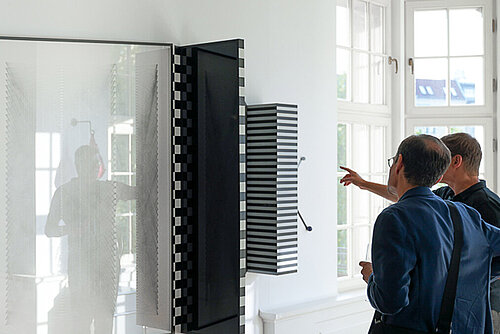
&co: In addition to painting, you have also worked intensively with glass. That's a completely different medium. What attracted you to it - and how does this work fit into your overall oeuvre?
UW: The owners of the Mayer'sche Hofkunstanstalt approached me after an exhibition in Munich and invited me to spend a week experimenting in their workshops. A few years later, I took this up again and developed it in a lengthy process, because the work is extremely demanding in terms of craftsmanship.
I was particularly interested in working with glass because of its proximity to watercolour. It is also about layering, transparency and working very precisely with light. At the same time, glass is extremely uncompromising: every layer is fired, decisions cannot simply be corrected. This forces a different form of concentration and responsibility in the process.
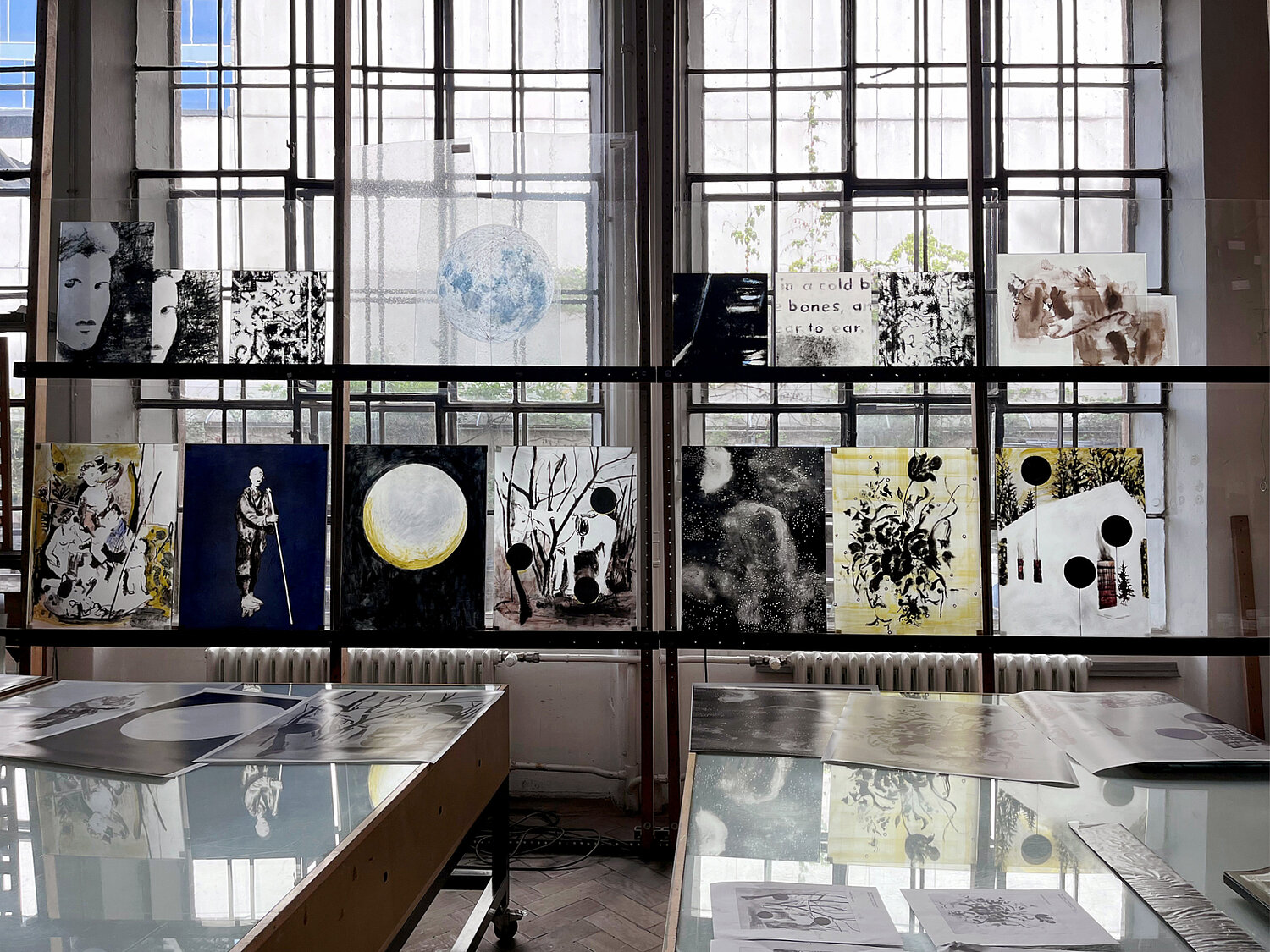
But what is almost as important to me is that glass work is never a solitary practice. It only works in close collaboration with specialised craftspeople. This joint work at eye level, the permanent harmonisation between artistic intention and technical feasibility, is very different from painting, where I stand alone in front of the picture.
In this respect, for me glass is not an escape from my work, but an extension and personal enrichment - a different way of dealing with similar issues, but under completely different conditions.
&co: How many steps does it take to create a work of art?
UW: I usually lay four, maximum five layers. Each layer is then fired overnight in the kiln. When I decide that the glass is ready for me, it goes into the hardening process. It is fired again and then shock-cooled. This changes the structure of the glass, it crumbles, just like a car windscreen, and is then very hard and fixed.
There is a great fascination in this very haptic work and the fragility of the medium.
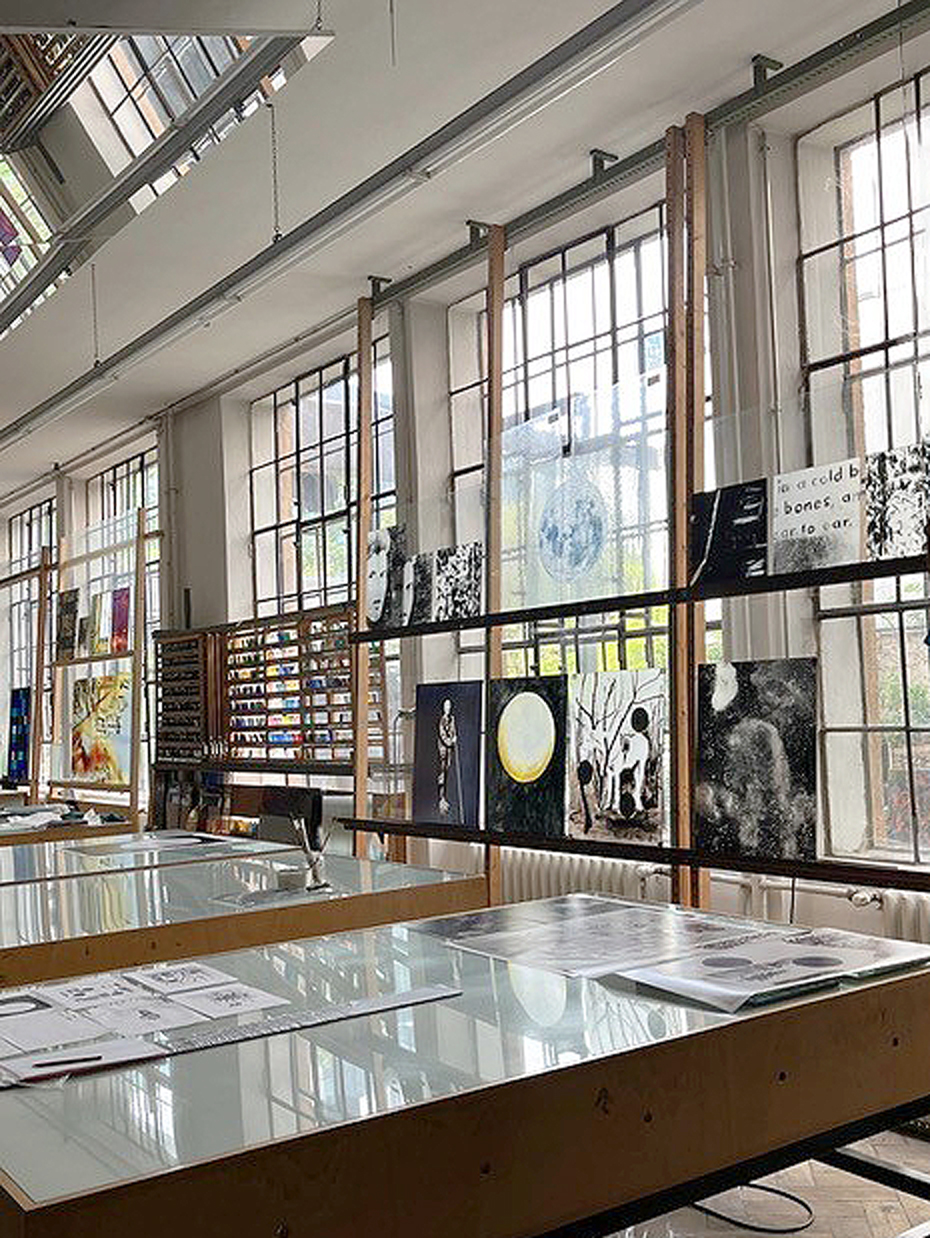
&co: Working with negatives plays an important role in your work. What interests you about this approach?
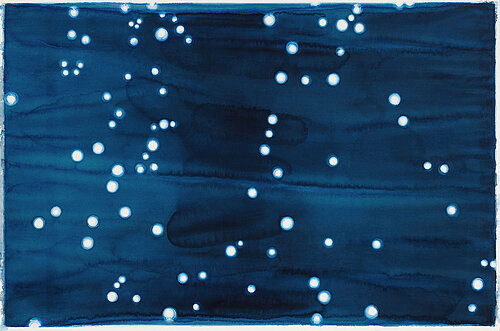
UW: Working with negatives has several levels for me. On the one hand, it is a return to early photography, in which the negative still had a visible, independent existence. Today, this intermediate step has practically disappeared, although it harbours enormous dialectical potential.
In watercolour, I always work "into the shadow" anyway, which is technically a given with the white of the paper. But this thinking in the negative also has a content-related dimension for me: it's about perception, about afterimages, about what remains when you don't show something directly.
I am interested in this moment of inversion - similar to the afterimage when you look at the sun for a long time and then close your eyes. You see something that is actually no longer there, but which nevertheless remains present. This moment of inversion is very important in my work.
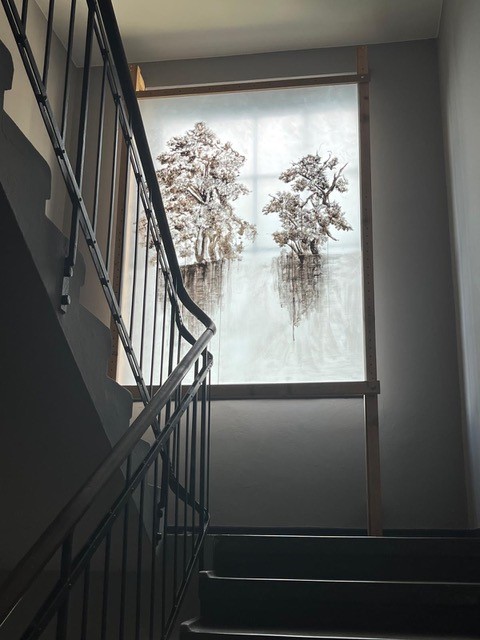
&co: What is it like for you to now exhibit in a company on its premises? Has that simply brought additional aspects for you?
UW: It's definitely different from the "white cube" of a gallery or a museum. In an office or corporate context, people don't just come for the art, but primarily to work. Art has a different role here - it should lighten or enrich the atmosphere, but also enter into a dialogue with people, even if they perceive it more casually.
But that doesn't really make much difference to the selection or hanging itself.
&co: That fits in very well, you fit in and challenge us to take a closer look and scrutinise things. We are already looking forward to this exciting inspiration in our workspaces.
Dear Uwe, thank you very much for the interview!
*The vernissage "Der Rat" with works that deepen these themes will take place on 11 June 2026 at 7 pm at undconsorten (Kurfürstendamm 194, 10707 Berlin).
Talk to us