
The AI-centred organisation
What AI actually makes possible in HR
AI in HR is no longer a topic for the future. Today, it manifests itself in four application clusters which, taken individually, seem unspectacular but which, taken together, shift the boundaries of what is possible:
- 24/7 interaction: e.g. HR chatbots answer questions about leave, benefits or policies at any time.
- Individualisation at scale: e.g. AI-curated L&D pathways, personalised for each employee.
- (Partial) automation of repetitive tasks, e.g. onboarding preparation with automatic provision of access, documents and tasks.
- Analyses & forecasts – e.g. attrition forecasting models as the basis for targeted retention measures.
However, the real lever lies not in individual use cases, but in the question of how HR as a whole must be structured to integrate these building blocks in a systematic and consistent manner. This is precisely where the following design principles come into play.
Six design principles for an AI-centred HR framework
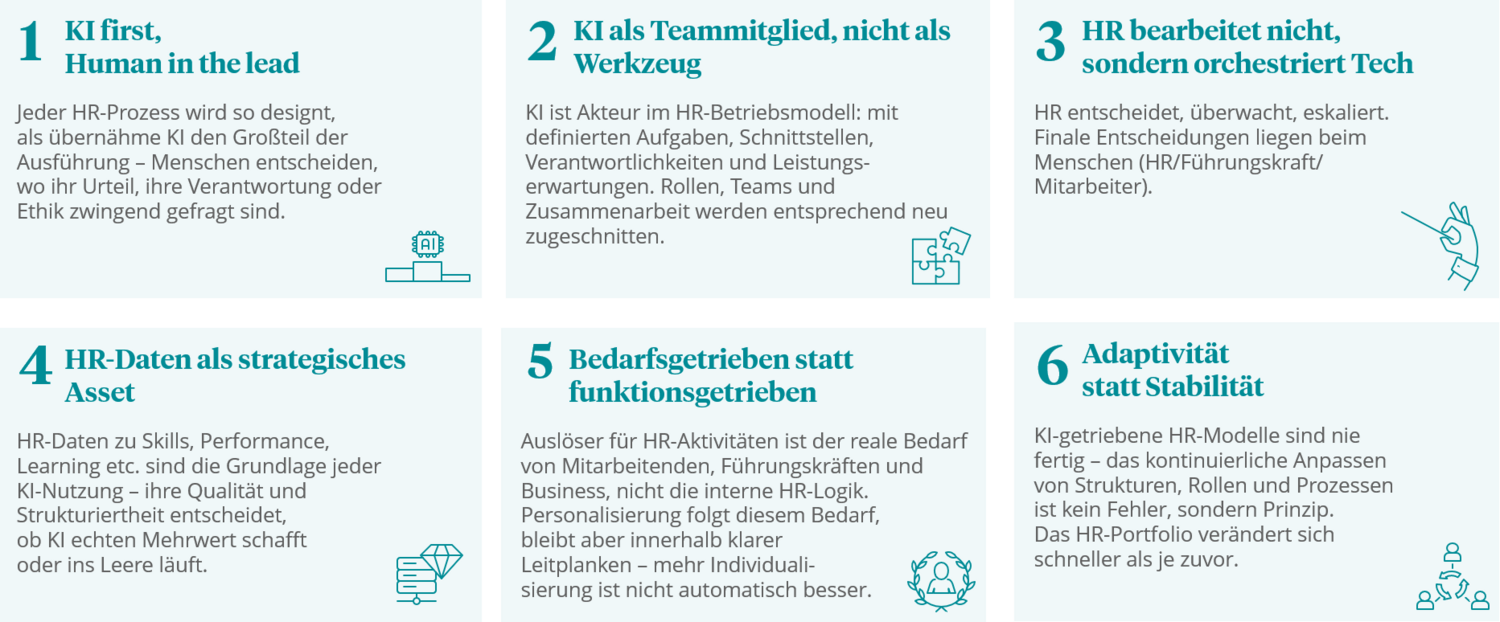
If HR were to be reimagined – not as an optimisation of the existing system, but as a response to the possibilities offered by AI – six design principles would guide us. They are not a catalogue of individual rules, but an expression of the same fundamental shift: HR is evolving from an executive function into a creative orchestrator. Many aspects of this are already familiar from the debate on digitalisation.
From the three-pillar model to the platform organisation
Design principles remain abstract unless they are translated into an organisational structure. This is precisely where it becomes clear why the classic three-pillar model is no longer sufficient as a solution: it was designed for a world in which HR executes processes – not for one in which AI executes and HR orchestrates.
What takes its place is neither a fourth pillar nor an expanded pillar model, but a different basic form: a platform organisation. Functions no longer stand side by side, but build upon one another – supported by a foundation of technology and data, upon which product development, consulting and management interact.
A word of warning: there is no one-to-one correspondence between old and new functions. Some roles are changing in substance, others are disappearing, and new profiles are emerging that HR simply does not have in sufficient numbers in-house today – for example, in data architecture, algorithm governance or product management. The transformation is therefore always a question of skills and personnel, not just a structural issue. Nevertheless, looking at the situation from the perspective of today’s three pillars is the most helpful way to understand the shift.
The AI-centred vision shows which roles HR will need in the future. However, it does not yet show how these roles interact to actually generate HR performance. This is precisely what the AI-centred value chain reveals. The AI-centred vision shows which roles HR will need in the future. However, it does not yet show how these roles interact to actually generate HR performance. This is precisely what the AI-centred value chain makes visible.
In the future, there will be more roles with different priorities and new skill sets
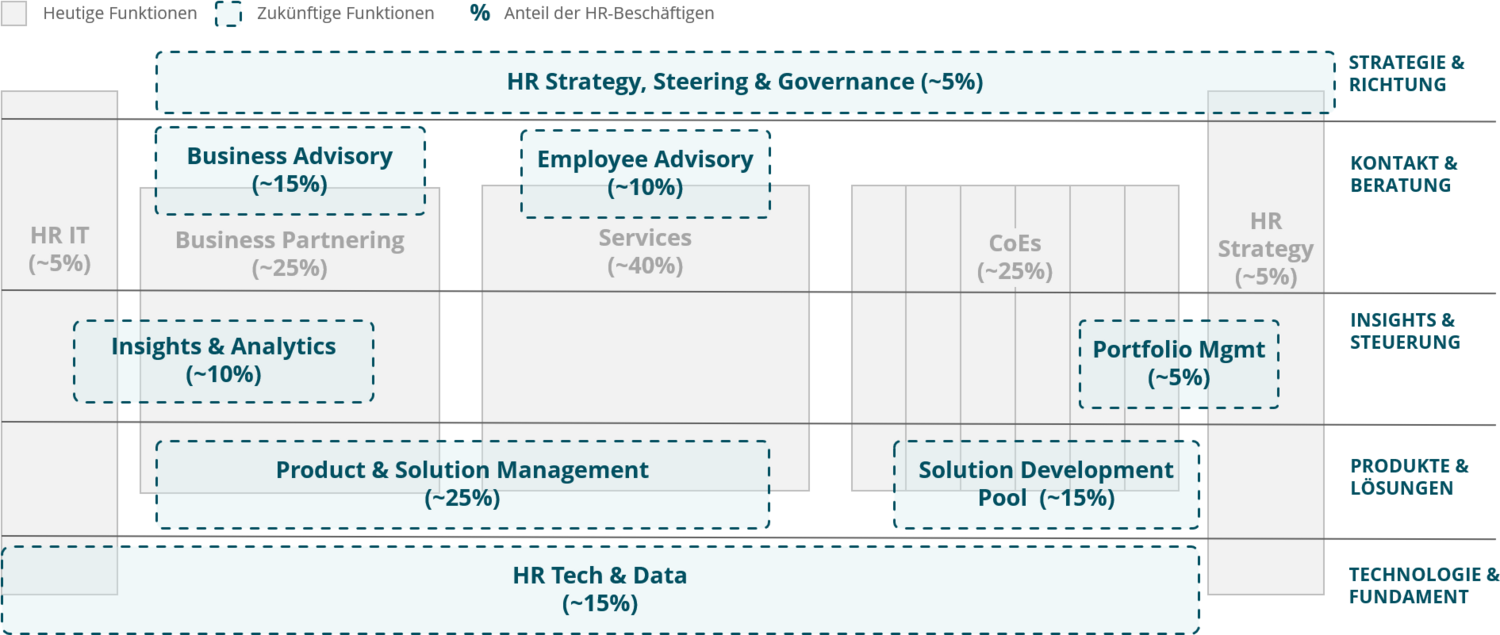
Business partnering is evolving into business advisory
The first pillar is shifting from a generalist support role to business advisory: AI provides systematic, data-driven insights into the organisation, teams and talent that were previously unavailable at this level of depth. This fundamentally shifts the role of the HR BP – from handling operational queries to acting as a catalyst for decision-making. HR BPs translate AI-driven insights into concrete implications for leadership, the organisation and people, identify what the organisation actually needs, and advise on new solutions.
Shared Services becomes Employee Advisory – smaller in scale but enhanced in quality
The second pillar is shrinking most visibly: AI agents and self-service are taking over the majority of standard enquiries. What remains and is gaining in importance is Employee Advisory – personal advice where self-service reaches its limits: complex cases, sensitive issues, escalations. “Broad-based service delivery” is becoming “in-depth advice”. Together with Business Advisory, it forms the customer-facing contact and advisory layer of the new organisation.
A new layer in between: Insights & Analytics and Portfolio Management
For consulting and solution development to be truly integrated, a dedicated layer for intelligence and steering is required. Insights & Analytics identifies customer needs from data and measures impact – the factual basis without which strategic consulting would remain a mere aspiration. Portfolio Management prioritises solutions based on impact and strategic contribution and ensures that not every idea becomes a project. Both functions are new in this form – they were not systematically embedded in the three-pillar model.
The CoEs are being replaced by two interrelated functions: Product & Solution Management and Solution Development Pool
The third pillar is undergoing the most significant change. The functionally organised silos of experts are dissolving – partly because AI makes expertise widely available: Product & Solution Management consistently develops HR offerings based on customer needs and ensures operations and delivery, with a focus on scalable AI/agent solutions. This is also where the functional responsibility and governance for parts of the HR portfolio lie. The Solution Development Pool provides the cross-functional, methodological and technical capacity in which these solutions are actually built and further developed. It comprises people with a shared foundation in tech and AI, but with different specialist focuses – depending on the product, these might include learning design, process and automation work, data science or change. These are profiles that are virtually unheard of today.
The foundation: HR Tech & Data
Amidst all this, HR Tech & Data is evolving from its previous supporting role into a core strategic function. Tech stack, data quality and algorithm governance form the infrastructure upon which everything else operates.
The overarching framework: HR Strategy, Steering & Governance
Across the entire platform, HR Strategy, Steering & Governance acts as the strategic foundation of the organisation, with AI governance as an explicitly new management task. It provides direction, sets guidelines and connects the layers into a coherent whole.
Much of this is not entirely new. Rather, it finally delivers on promises that have been made time and again since Ulrich’s original reflections, but rarely consistently fulfilled: strategic advice on an equal footing with the business and a clear separation of routine tasks and value creation. Added to this is a dimension that Ulrich had not yet envisaged, but which is indispensable today: data and technology expertise as an integral part of HR.
The AI-centred HR value chain
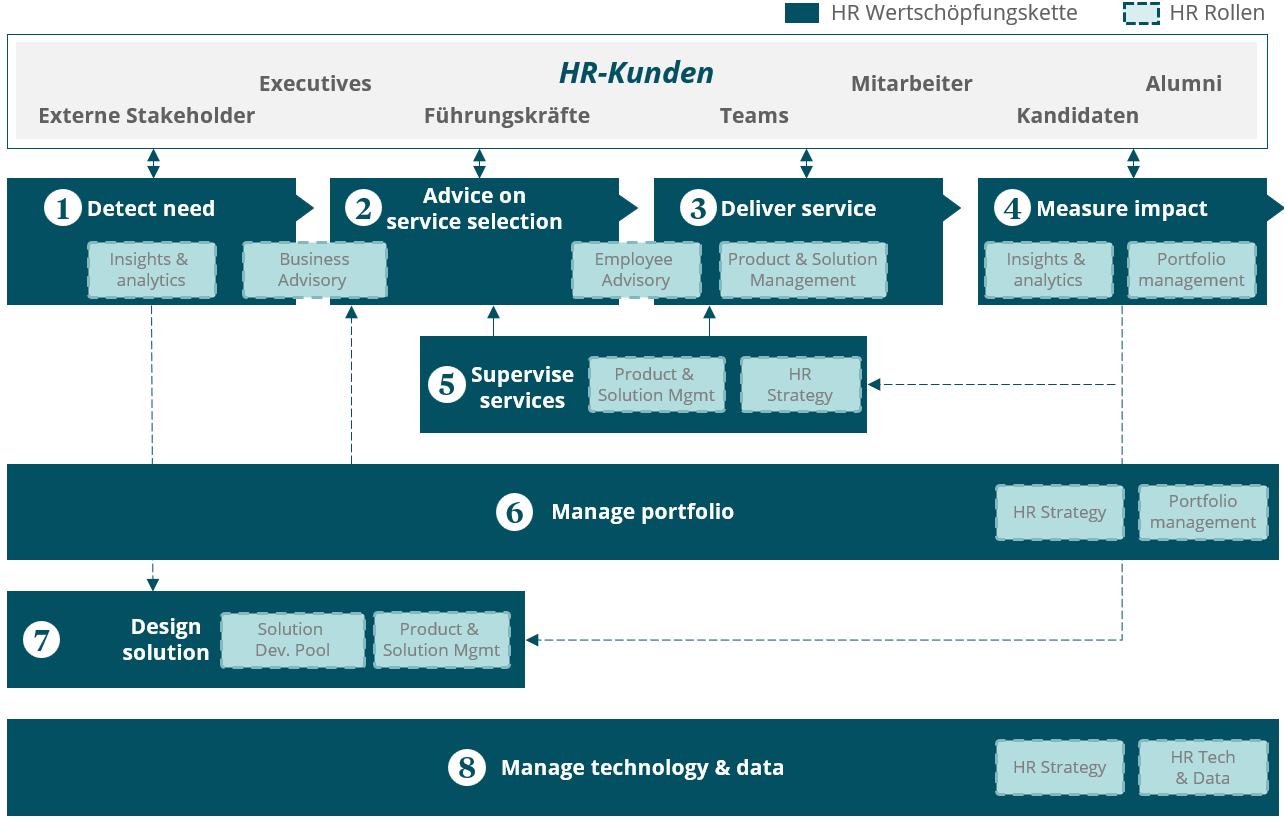
The AI-centred vision outlines the roles HR will need in the future. However, it does not yet show how these roles interact to actually deliver HR performance. This is precisely what the AI-centred value chain brings to light.
An analogy helps: in future, HR will function more like a modern software company than a traditional administrative function. Needs are identified from usage data, solutions are configured from reusable building blocks, delivered continuously, measured in real time and further developed based on their impact. People remain central, but in different areas than today: where judgement, relationships and responsibility matter.
The key changes along the chain can be grouped into three patterns:
a) Anticipating rather than reacting: HR identifies needs before they are asked for
Today, HR reacts to reported needs – via standard processes, governance cycles or escalations from the business. In future, AI will proactively identify areas requiring action from data patterns (engagement, remuneration, performance, turnover risk) and suggest personalised measures. The customer benefit determines where this occurs as a supplement and where it replaces existing processes. HR validates, prioritises and decides. (Stages: (1) Detect Need, (2) Advice on Service Selection)
b) Configure rather than execute: AI delivers, humans intervene where necessary
Solutions are no longer designed and implemented manually for every individual case, but are configured from AI and agent modules and delivered in a customised form. Personalised advice is focused where it truly adds value: on complex leadership, career or conflict issues. (Stages: (3) Deliver Service, (7) Design Solution)
c) Controlling rather than documenting: measuring impact and quality becomes a core task
Impact is no longer assessed retrospectively and on a random basis, but is continuously measured against business outcomes. AI inputs and outputs are actively monitored; the portfolio is managed on an evidence-based rather than capacity-driven basis; data and technology shift from a supporting role in IT to the responsibility of HR. (Stages: (4) Measure Impact, (5) Supervise Services, (6) Manage Portfolio, (8) Manage Technology & Data)
The individual changes are logical in themselves, but their impact only emerges through their interaction along the chain. Anyone who merely sets up AI-supported demand identification without considering delivery and impact measurement will gain additional data but little impact.
And yes: this is not a roadmap for the next quarter. Much of it lies further in the future, depending on data maturity, technological development and regulatory frameworks. It remains a bit of a crystal ball, but one that helps steer today’s decisions in the right direction.